
Digital marketing is transforming at record speed, with performance-based models set to dominate by 2026. As ecommerce, fashion, beauty, and lifestyle brands demand clear ROI and real accountability, traditional agency partnerships are quickly evolving.
The shift to a performance based marketing agency unlocks scalable growth, measurable results, and a new level of partnership transparency. For brands seeking to maximize every marketing dollar, this approach offers a powerful, results-driven framework.
This guide delivers a step-by-step playbook for choosing, collaborating with, and excelling alongside a performance based marketing agency in 2026. You will discover the strategies, best practices, and trends that are redefining agency success for the next era.
What Is a Performance Based Marketing Agency?
Success in digital marketing today demands more than creative campaigns. Brands in ecommerce, fashion, and beauty are moving toward models that guarantee measurable business growth. This is where a performance based marketing agency stands apart, offering a results-driven partnership built on accountability.
Defining Performance Based Marketing
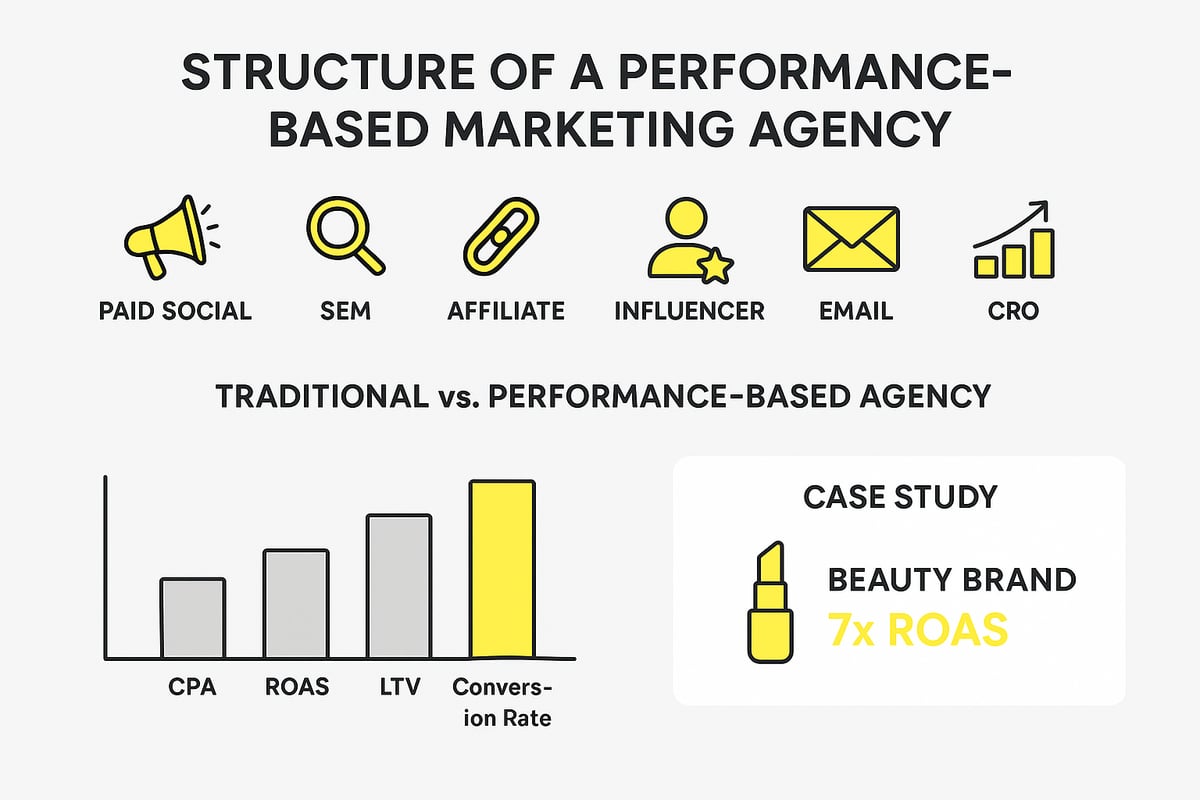
A performance based marketing agency is compensated only when it delivers agreed-upon outcomes. These outcomes may include sales, qualified leads, or specific returns on ad spend (ROAS). Unlike traditional agencies that charge for time or deliverables, this model ensures every dollar is tied to tangible business growth.
Key performance metrics include:
| Metric | Definition |
|---|---|
| CPA | Cost per acquisition, tracks spend per sale |
| ROAS | Return on ad spend, measures campaign revenue |
| LTV | Lifetime value, predicts customer worth |
| Conversion Rate | Percentage of users who take desired action |
Data-driven decision-making is central. Agencies analyze every ad, click, and purchase to optimize spend. For example, a fashion brand might pay its agency based solely on sales generated from Meta ads. According to Statista, by 2026, over 60% of ecommerce brands will allocate at least half their marketing budgets to performance-based models.
A notable case is a beauty brand that transitioned from a flat retainer to a performance based marketing agency, achieving a remarkable 7x ROAS within six months. To understand more about the strategic frameworks and service options, explore this Performance Marketing Services Overview.
Types of Performance Based Marketing Services
A performance based marketing agency typically offers a suite of services:
- Paid social campaigns on Meta, TikTok, Pinterest
- Search engine marketing (SEM)
- Affiliate and influencer programs
- Email marketing and automation
- Conversion rate optimization (CRO) and landing page design
Integration is key. For instance, lifestyle brands often rely on high-converting ad creatives tailored for different platforms. In health and wellness, agencies use performance-driven user-generated content (UGC) campaigns to build trust and drive sales. CRO is a core offering, ensuring landing pages and checkout flows maximize conversion rates.
Step by step, agencies audit your existing channels, develop a cross-platform creative strategy, and test continuously for the highest ROI. Their focus is always on business results, not just marketing activity.
Key Benefits for Brands in 2026
Partnering with a performance based marketing agency delivers several advantages:
- Full accountability and transparent reporting
- Efficient budget allocation to what actually works
- Alignment with your business goals, like scaling DTC sales or international launches
- Faster learning cycles and campaign iteration
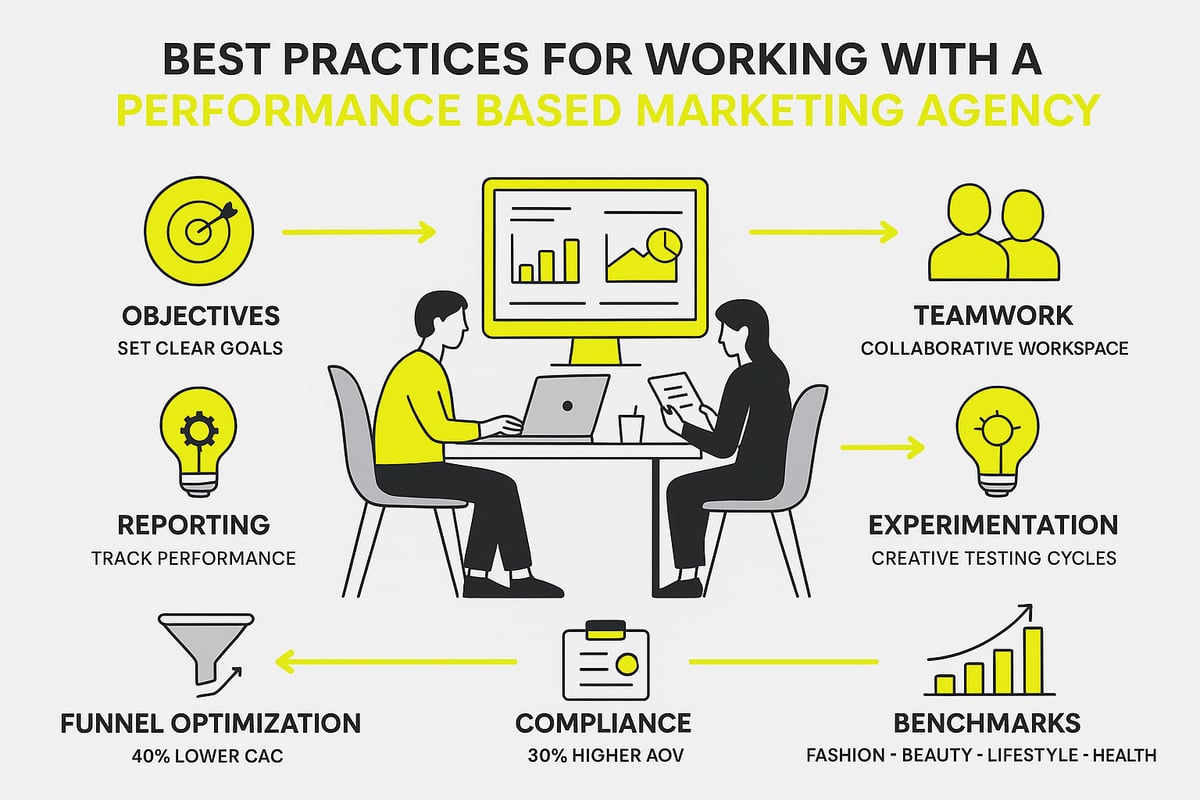
Shopify Plus reports that brands using these agencies see up to 40% lower customer acquisition costs and 30% higher average order values compared to traditional models. For example, a home and living brand shifted its spend to a performance model and quickly identified the channels driving the best results, allowing rapid scale.
In 2026, the performance based marketing agency model is not just a trend but a proven strategy for brands seeking profitable, scalable growth.
How Performance Based Marketing Agencies Drive Success
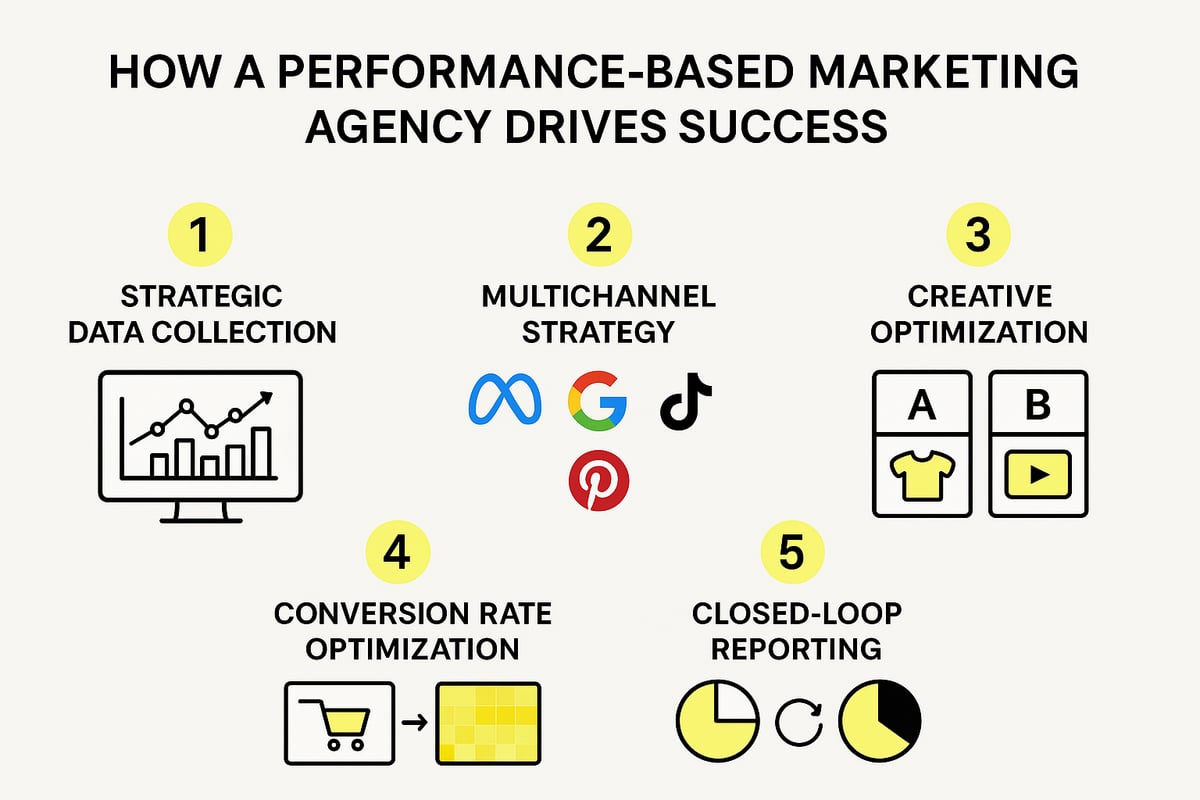
A performance based marketing agency uses a data-driven, results-focused approach to deliver measurable growth for brands. Their process is built around transparency, rapid iteration, and a relentless focus on ROI. Here is a concrete, step-by-step breakdown of how these agencies drive success for brands across ecommerce, fashion, beauty, home, and wellness.
Step 1: Strategic Data Collection & Baseline Analysis
The journey begins with a comprehensive audit. A performance based marketing agency will integrate analytics from your website, ad platforms, and CRM to establish clear benchmarks. This means tracking every user touchpoint, from the first ad impression to final checkout.
For example, a lifestyle retailer might discover their highest cart abandonment rates occur on mobile devices. By identifying these patterns early, the agency sets realistic KPIs such as current cost per sale, average order value, and conversion rate.
Agencies ensure all data is clean and actionable. They use tools like Google Analytics, Shopify, or custom dashboards, allowing brands to monitor progress transparently. Baseline analysis lays the foundation for every optimization to follow.
Step 2: Multichannel Performance Strategy
Next, the performance based marketing agency designs a multichannel strategy that reaches your customers wherever they are. Instead of relying on a single channel, campaigns span Meta, Google, TikTok, Pinterest, and email.
This approach diversifies risk and uncovers the most profitable channels for each audience segment. For instance, a fashion brand may achieve the best ROAS on TikTok for Gen Z shoppers, while Google Shopping delivers for older customers. Industry data shows that brands using three or more channels see a 287 percent higher purchase rate.
The agency regularly reviews channel performance, reallocating budgets in real time. This ensures your spend is always directed to the highest-converting platforms.
Step 3: Creative & Content Optimization
A performance based marketing agency knows that data and creativity must work together. They run structured A/B tests on ad formats, messaging, and visuals to find what resonates with your audience.
Consider a home decor brand that refreshes its ad creatives and sees a 25 percent increase in click-through rate. Agencies balance storytelling with conversion-focused tactics, using UGC, influencer content, and high-impact visuals.
Lists of creative tests might include:
- Static image vs. video ads
- Different CTA button colors
- Seasonal vs. evergreen messaging
These rapid experiments allow brands to identify winning creative fast and scale results.
Step 4: Conversion Rate Optimization (CRO)
Optimizing the user journey is critical. The performance based marketing agency conducts thorough CRO across landing pages, checkout flows, and calls-to-action.
They deploy heatmaps, user session replays, and funnel analysis to pinpoint friction points. For example, a beauty brand might reduce cart abandonment by 18 percent after simplifying its checkout process and improving mobile UX.
For more actionable CRO tactics, see these Conversion Rate Optimization Strategies.
CRO is a continuous process, with agencies routinely testing and refining to remove obstacles and boost conversion rates.
Step 5: Closed-Loop Reporting & Iteration
Finally, a performance based marketing agency delivers closed-loop reporting by merging marketing and sales data for true end-to-end attribution. Brands receive real-time dashboards and actionable insights.
Continuous improvement is baked into the process. Agencies shift budgets to top-performing campaigns, pause underperforming ones, and test new ideas. According to eMarketer, these agencies achieve a 33 percent faster time to ROI improvement compared to traditional models.
This iterative approach ensures brands never stand still, always adapting to market trends and customer behaviors.
Key Best Practices for Working with a Performance Based Marketing Agency
To unlock the full potential of a performance based marketing agency, brands must approach the partnership strategically. Success in 2026 requires a blend of clear objectives, transparent processes, and a culture of continuous optimization. Below are actionable best practices, tailored for ecommerce, fashion, beauty, lifestyle, health, and home sectors.
Set Clear, Aligned Objectives
Start by defining what success means for your brand. Do you want to increase monthly sales, expand internationally, or boost customer retention? Set specific, measurable goals, such as "achieve 1,000 new customers per quarter" or "reduce CAC by 20 percent in six months."
Align your agency’s KPIs with your business objectives. For example, a health supplement brand might target a set number of new subscriptions per quarter, while a fashion retailer could focus on a specific ROAS for seasonal campaigns.
Share these objectives upfront and revisit them regularly to ensure alignment as your partnership evolves with the performance based marketing agency.
Establish Transparent Reporting and Communication
Insist on real-time dashboards and consistent reporting. Transparency builds trust and enables rapid decision-making. Weekly email updates and monthly strategy calls keep everyone informed and accountable.
Share all relevant data, from sales and inventory to customer feedback. For example, a lifestyle brand that provides full access to its CRM and web analytics empowers the agency to optimize campaigns more precisely.
Regular check-ins foster proactive problem-solving and help both teams stay agile, making the most of your investment in a performance based marketing agency.
Foster Collaborative Partnerships
Treat the agency as an extension of your in-house team. Share brand guidelines, creative assets, and market insights, so strategies reflect your unique identity.
Co-develop campaigns for greater impact. A fashion brand might work closely with the agency to craft a seasonal launch, combining internal know-how with the agency’s market expertise. For more inspiration, explore Case Studies of Ecommerce Brands to see how collaboration drives measurable results.
This approach ensures your performance based marketing agency has the context and resources needed for success.
Embrace Test-and-Learn Culture
Encourage rapid experimentation. Approve budgets for creative sprints, audience segmentation tests, and channel trials. Celebrate both wins and insights gained from failed tests.
For instance, a home and living brand might run monthly creative iterations, uncovering which visuals resonate best. This agile mindset helps the performance based marketing agency quickly identify high-performing tactics.
Document learnings and apply them to future campaigns, fueling ongoing improvement and ROI growth.
Prioritize Full-Funnel Optimization
Effective agencies align strategies across the entire customer journey. From top-of-funnel awareness to bottom-of-funnel conversion, ensure every touchpoint is optimized.
A beauty brand might use influencer UGC for awareness, detailed product demos for consideration, and personalized retargeting for conversion. This holistic approach, managed by a performance based marketing agency, maximizes the impact of your ad spend.
Integrate tools like funnel analysis and user feedback to spot bottlenecks and unlock new growth opportunities.
Ensure Compliance and Brand Safety
Demand strict adherence to privacy laws, platform policies, and industry regulations. Health brands, for example, must ensure all ads meet compliance standards to avoid costly takedowns or penalties.
Work with your performance based marketing agency to review creative and messaging before launch. This step safeguards your brand reputation and builds consumer trust.
Stay updated on regulatory changes, and schedule regular compliance audits as part of your standard workflow.
Leverage Industry Benchmarks and Trends
Use sector-specific data to calibrate your expectations and goals. Compare KPIs like ROAS, CAC, and AOV with industry standards for similar brands.
For example, a lifestyle retailer can benchmark its performance against averages in the home and living sector, identifying areas for improvement. Your performance based marketing agency should provide regular insights on emerging trends and competitor strategies.
This data-driven approach ensures your campaigns remain competitive and future-proof.
Step-by-Step Guide: Implementing Performance Based Marketing for Your Brand in 2026
Adopting a performance based marketing agency model in 2026 requires a structured, data-driven approach. The following step-by-step guide outlines exactly how leading brands in fashion, beauty, lifestyle, health, and home living sectors can implement this strategy for measurable growth.
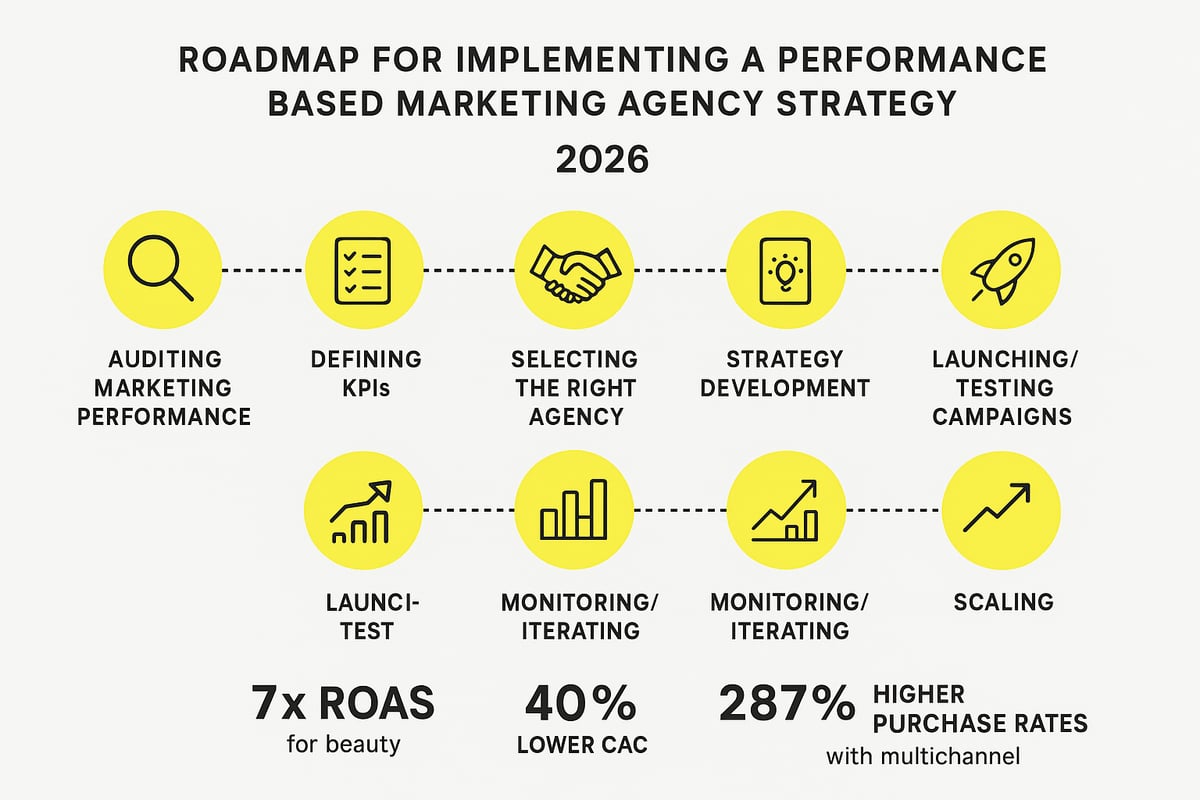
Step 1: Audit Your Current Marketing Performance
Begin by gathering comprehensive baseline data. Review traffic sources, conversion rates, customer acquisition cost (CAC), lifetime value (LTV), and return on ad spend (ROAS). Use analytics platforms like Google Analytics, Shopify, or Triple Whale for accuracy.
- List all active channels and campaigns
- Identify high and low-performing assets
- Pinpoint inefficiencies or gaps
For instance, an ecommerce brand in the fashion sector discovered that while Meta ads consumed 60 percent of their budget, the ROAS was below 2x, highlighting a need for change. This audit sets a solid foundation for collaborating with a performance based marketing agency.
Step 2: Define Success Metrics and Incentive Structure
Set clear, measurable objectives that align with your business goals. Typical metrics include target CAC, monthly new customer counts, ROAS, and AOV. Decide how your performance based marketing agency will be compensated—options include a percentage of ad spend, cost per acquisition, or revenue share.
- Establish baseline KPIs for each channel
- Define incentive tiers for over-performance
- Ensure alignment with internal sales targets
A beauty brand negotiated a tiered bonus system with their agency, providing extra incentives for exceeding monthly sales targets. This encourages your performance based marketing agency to focus on outcomes, not just activity.
Step 3: Select the Right Performance Based Marketing Agency
Evaluate potential partners based on their experience in your industry, transparency, and proven results. Request case studies, review client testimonials, and assess their tech stack for real-time reporting.
- Shortlist agencies with sector-specific expertise
- Check for access to live dashboards and clear reporting
- Assess creative and technical capabilities
A home decor retailer chose an agency with a track record of Pinterest success, resulting in a 4x increase in qualified leads within three months. The right performance based marketing agency can make a measurable difference.
Step 4: Develop a Unified Strategy & Creative Brief
Work collaboratively with your chosen performance based marketing agency to define customer personas, refine brand messaging, and plan creative direction. Align on the optimal channel mix and budget allocation for your objectives.
- Share audience insights and historical data
- Co-create a creative brief covering visuals and copy
- Prioritize channels based on past performance and audience trends
A health and wellness brand prioritized TikTok and email for their Q2 launch, leveraging agency expertise to craft high-converting UGC content. This unified approach ensures your performance based marketing agency drives consistent brand experience across touchpoints.
Step 5: Launch, Test, and Optimize Campaigns
With strategy and tracking in place, activate campaigns across selected platforms. Implement robust tracking using UTMs and pixels. Approve budgets for rapid A/B testing of creative, audiences, and offers.
- Launch initial campaigns with clear test hypotheses
- Monitor performance daily, adjust budgets quickly
- Run creative sprints to identify top-performing content
A fashion brand shifted 40 percent of their spend to winning creative after a week of testing, driving a 50 percent boost in ROAS. For actionable tactics, explore Low Cost, High Return Tactics to maximize campaign impact with your performance based marketing agency.
Step 6: Monitor, Report, and Iterate
Schedule weekly or monthly performance reviews with your performance based marketing agency. Use shared dashboards for real-time insights and hold regular strategy calls to discuss next steps.
- Pause underperforming campaigns quickly
- Reallocate budgets to top-performing channels
- Document learnings from each test
A lifestyle brand halted low-ROAS Google campaigns after two weeks, redirecting spend to Meta where conversions were 3x higher. Continuous iteration ensures your performance based marketing agency stays aligned with your evolving business needs.
Step 7: Scale What Works
As you identify high-performing channels and creatives, increase investment and explore new markets or audiences with your performance based marketing agency. Double down on scalable tactics and expand successful programs.
- Increase budgets for best-performing campaigns
- Test offers or creatives in new regions
- Build on influencer or UGC programs that demonstrate strong ROI
A beauty brand scaled its influencer program after a pilot delivered 3x ROAS, fueling rapid growth across international markets. The result: a sustainable path to scaling with your performance based marketing agency.
Selecting the Best Performance Based Marketing Agency: Criteria & Questions
Choosing the right performance based marketing agency is critical to unlocking measurable growth in 2026. The selection process requires a methodical approach, focusing on experience, transparency, technical expertise, strategic onboarding, the right questions, and avoiding common pitfalls.
Industry Experience and Track Record
Start by evaluating the agency’s track record in your sector. A performance based marketing agency with deep experience in fashion, beauty, or home and living is more likely to deliver results that align with your brand’s objectives.
For instance, a fashion brand seeking international expansion might prioritize agencies with a proven 7x ROAS for similar brands. According to Digital Agency Industry Statistics 2026, over 60 percent of digital agencies specialize in performance models by 2026, making sector expertise a key differentiator.
Ask for detailed case studies and client testimonials that demonstrate success in your vertical. Review metrics like average order value increases, lower customer acquisition costs, and campaign scalability.
Data Transparency and Reporting Tools
Transparency is non-negotiable when partnering with a performance based marketing agency. Ensure you have access to real-time dashboards, such as Google Data Studio or Triple Whale, that track core KPIs.
A home and living brand, for example, might require weekly performance snapshots to identify trends and quickly reallocate budgets. Agencies should offer granular reporting, including channel-level attribution, spend breakdowns, and conversion rates.
Look for clear processes around data sharing and schedule regular review meetings to keep communication open. This approach helps you make swift, informed decisions based on up-to-date results.
Technical and Creative Capabilities
Your chosen performance based marketing agency must excel in both technical optimization and creative production. This means leveraging advanced analytics, A/B testing, and AI-driven insights to maximize campaign impact.
Lifestyle brands often benefit from agencies that combine UGC, CRO, and paid social strategies. As noted in AI-Driven Performance Marketing Trends 2025, the integration of AI and automation is transforming creative testing and scaling.
Assess the agency’s ability to deliver high-converting creative assets, run multichannel campaigns, and adapt quickly to changing trends.
Strategic Approach and Onboarding Process
A structured onboarding process sets the stage for a successful partnership with your performance based marketing agency. Look for agencies that start with a thorough discovery phase, mapping your customer personas, brand guidelines, and business goals.
For example, a health and wellness brand might value agencies that provide quarterly planning sessions and detailed launch frameworks. The onboarding should include setting clear KPIs, establishing communication protocols, and aligning on creative direction.
Effective onboarding ensures alignment from day one and accelerates time to results.
Questions to Ask Potential Agencies
Prepare a targeted list of questions to assess each performance based marketing agency’s fit:
- What KPIs do you recommend for our business model?
- How do you handle creative testing and optimization?
- Can you share recent case studies for brands in our category?
- What reporting tools and dashboards do you provide?
- How do you manage budget allocation and scaling?
- What is your process for onboarding new clients?
Use these questions to compare agencies objectively and uncover strengths or gaps in their approach.
Red Flags to Avoid
Remain vigilant for signs that a performance based marketing agency may not be the right partner:
- Reluctance to share data or lack of transparency
- Overpromising results without a clear methodology
- Inflexible contracts or hidden fees
- Limited experience in your sector
- Poor communication or slow response times
Spotting these red flags early protects your brand and ensures a smooth, productive collaboration.
Future Trends: The Evolution of Performance Based Marketing Agencies by 2026
Performance based marketing agency models are transforming rapidly, driven by technology, data, and evolving brand needs. As we approach 2026, agencies must adapt to a landscape where AI, omnichannel strategies, and creative innovation intersect. Here are the key trends shaping the future, with actionable steps and industry examples.
AI and Automation in Performance Marketing
AI is revolutionizing how a performance based marketing agency operates. Agencies now use predictive analytics to allocate budgets and optimize creative in real-time. For example, fashion brands deploy AI-driven dynamic creative to tailor ads for each audience segment, increasing engagement and ROI. To dive deeper into these frameworks, see Generative AI in Marketing Strategy.
Step-by-step:
- Integrate AI tools for budget and creative decisions.
- Analyze campaign data daily for rapid adjustments.
- Test AI-generated ad variations for each audience.
Omnichannel and Cross-Platform Attribution
A modern performance based marketing agency must unify tracking across channels like Meta, TikTok, Google, Pinterest, and email. Home and living brands now attribute sales to multi-touch customer journeys, ensuring no touchpoint is overlooked.
Action steps:
- Implement cross-platform attribution software.
- Map each customer journey in your CRM.
- Review attribution data weekly to optimize spend.
Creative-Performance Integration
Agencies are blending brand storytelling with data-driven conversion tactics. For example, beauty brands use user-generated content (UGC) and AI personalization to create ads that resonate emotionally and drive action.
How to achieve this:
- Gather UGC from real customers.
- Use AI to personalize messaging and visuals.
- A/B test story-driven vs. direct response creatives.
Privacy, Compliance, and First-Party Data
A leading performance based marketing agency in 2026 prioritizes compliant data collection. Lifestyle brands are building owned audiences via email and SMS, reducing reliance on third-party cookies. According to Performance Marketing Strategies 2025, zero-party data will be crucial for targeting and personalization.
Steps to stay compliant:
- Collect email and SMS opt-ins at every touchpoint.
- Regularly audit data practices for privacy compliance.
- Invest in secure, first-party data management tools.
Rise of Micro-Influencers and UGC
Performance agencies are scaling micro-influencer and UGC programs to drive lower-funnel results. Health and wellness brands report 40 percent higher conversions from micro-influencer content compared to traditional ads.
Quick wins:
- Identify niche influencers in your vertical.
- Launch pilot UGC campaigns.
- Measure conversions from influencer-sourced traffic.
Metrics That Matter in 2026
A performance based marketing agency is moving beyond ROAS to focus on lifetime value (LTV), retention, and incrementality. Fashion brands now optimize for repeat purchase rates, not just first sales.
Actionable steps:
- Track LTV and retention by cohort.
- Set benchmarks for incrementality.
- Align agency compensation with long-term value, not just short-term gains.
The Agency-Brand Partnership Model
The relationship between brand and performance based marketing agency is evolving into an embedded partnership. Home and living brands now work with agencies as part of the growth team, with shared dashboards and outcome-based compensation.
How to foster this:
- Share real-time dashboards with your agency.
- Hold joint quarterly planning sessions.
- Align incentives and KPIs for shared success.
Performance based marketing agency teams that embrace these trends will lead the next era of digital growth. Brands that demand innovation, transparency, and measurable impact will thrive alongside their agency partners.
After exploring how performance based marketing agencies can drive measurable growth and brand impact, you might be wondering what the next step looks like for your business. The landscape in 2026 is all about combining creativity with data to achieve results you can actually see—whether that's higher ROAS, lower acquisition costs, or stronger customer loyalty. If you're ready to find out how Good Karma Agency can help your brand walk that fine line between brand excellence and performance, let's have a conversation. Take the first step toward scalable, accountable marketing—Contact us.


