
Ecommerce brands are facing fiercer competition and rising customer acquisition costs in 2026. With 79% of brands now calling paid ads essential, mastering ecommerce ppc management is more important than ever. This guide delivers practical, up-to-date strategies to help your team stay ahead and maximize ROAS.
Inside, you’ll find step-by-step tactics for choosing the right PPC platforms, setting up high-converting campaigns, optimizing for profit, analyzing data, and scaling sustainably. Proven examples from leading fashion, beauty, lifestyle, and home brands show what works now. If you’re ready to double your results and future-proof your ecommerce ppc management, let’s dive in.
Understanding Ecommerce PPC Management in 2026
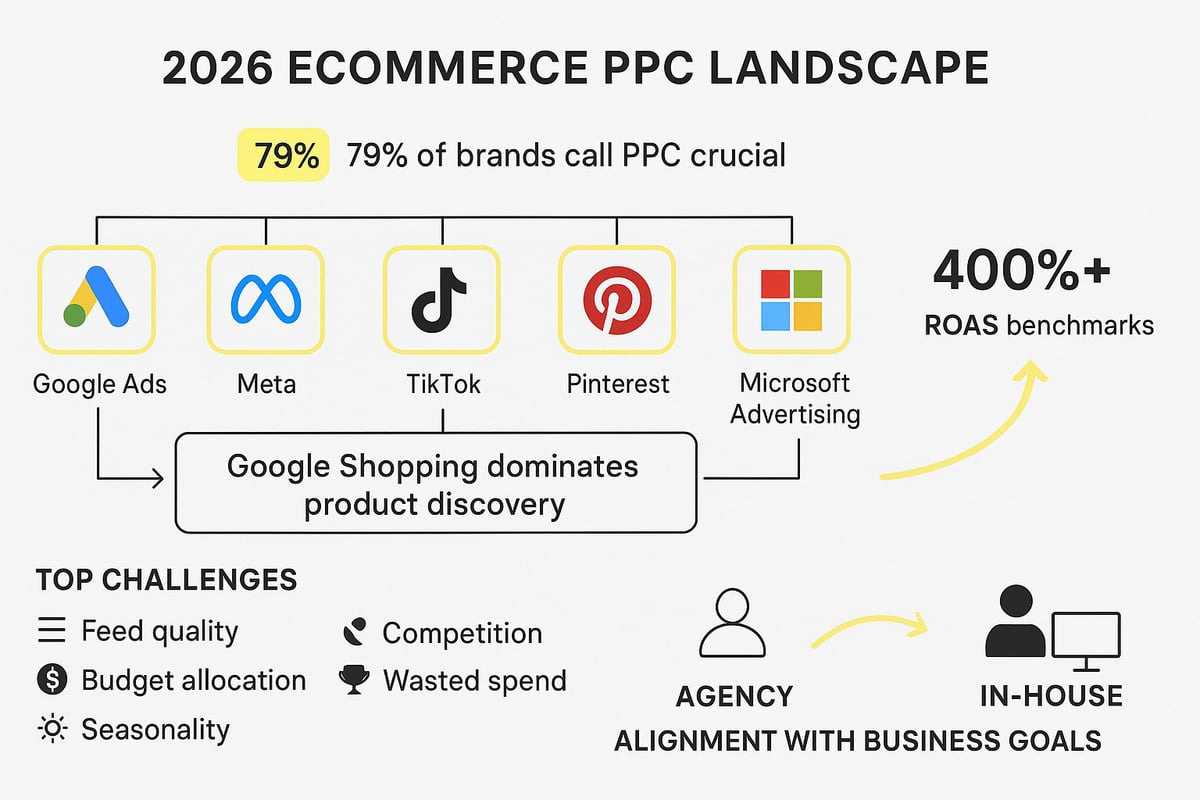
As ecommerce competition surges in 2026, mastering ecommerce ppc management is mission-critical for brands aiming to drive sales efficiently. Let’s break down what it means, which platforms matter most, why it drives business growth, and the common hurdles you’ll need to overcome.
Defining Ecommerce PPC Management
Ecommerce ppc management is the process of running pay-per-click campaigns designed to generate online sales. Unlike SEO or organic social, which build traffic over time, PPC delivers immediate, measurable results by placing your products in front of shoppers actively searching or browsing.
Effective ecommerce ppc management involves structured planning, precise campaign setup, ongoing optimization, and detailed reporting. Brands may choose to work with in-house teams or specialized agencies, but the key is always aligning PPC activity with broader business goals.
For instance, a fashion retailer launching a new collection might use Google Shopping and Meta Ads to reach target audiences instantly. Notably, 79% of brands now consider PPC essential for ecommerce success, underscoring its growing impact.
Key Platforms: Google, Microsoft, and Social Channels
Choosing the right platforms is a cornerstone of ecommerce ppc management. Google Ads and Google Shopping offer unmatched reach and intent targeting, while Microsoft Advertising provides cost-efficient access to a unique audience. Social platforms like Meta (Facebook/Instagram), TikTok, and Pinterest are vital for retargeting, brand awareness, and visually-driven product discovery.
Beauty brands often leverage Instagram Ads to create buzz around product launches, using shoppable posts to drive conversions. Google Shopping remains the leader in product discovery across most verticals, thanks to its integration with Google Merchant Center.
A cross-channel approach maximizes full-funnel engagement. For advanced strategies that blend these platforms, partnering with performance marketing services for ecommerce can deliver scalable, data-driven results.
The Business Case: ROAS, Profitability, and Growth
The main metric in ecommerce ppc management is ROAS (Return on Ad Spend), which measures revenue generated per dollar spent. High-performing ecommerce brands typically target at least 400% ROAS, creating room for reinvestment and sustainable scaling.
Balancing aggressive growth with profitability means tracking metrics like Marketing Efficiency Ratio (MER), gross profit, and customer lifetime value (LTV). For example, a home and living brand might shift budget between product categories based on which deliver the strongest ROAS.
PPC campaigns can convert up to 50% higher than organic traffic, making them a powerful growth lever. The focus should remain on sustainable, profitable outcomes, not just vanity metrics.
Common Challenges in Ecommerce PPC
While ecommerce ppc management offers major benefits, it comes with real challenges. Managing product feed complexity, especially for large catalogs, requires constant attention to data quality. Allocating budgets between high- and low-margin categories, dealing with seasonal demand shifts, and inventory volatility can all impact performance.
Competitor bidding wars on popular search terms often drive up costs. Without careful targeting, brands risk wasted spend from irrelevant clicks. For example, a lifestyle retailer might see efficiency drop if negative keywords are neglected.
Systematic, ongoing campaign management is essential to maintain profitability and outpace competitors in a rapidly evolving digital market.
Step-by-Step: Setting Up and Launching a High-Performance Ecommerce PPC Campaign
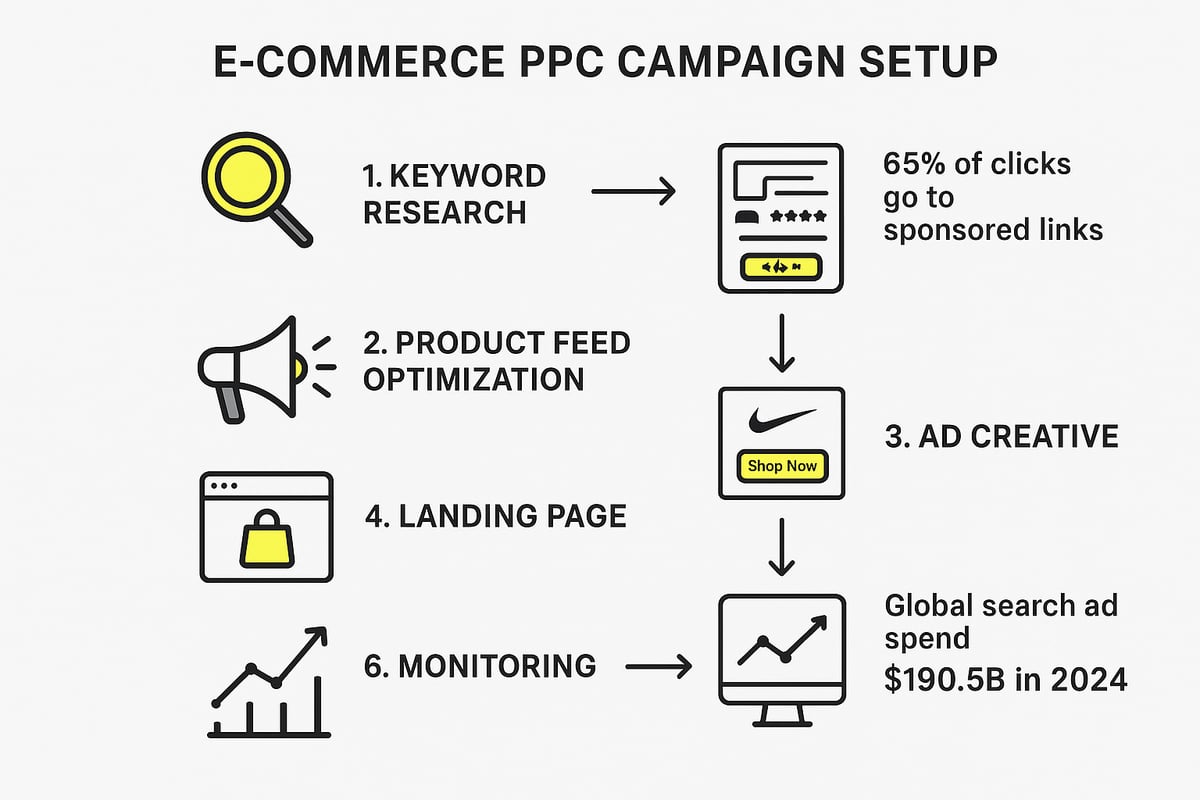
Launching a successful ecommerce ppc management program requires a systematic, data-driven approach. Each step, from keyword research to campaign launch, must be executed with precision to maximize return on ad spend and long-term growth.
1. Strategic Keyword Research for Ecommerce
Begin with in-depth keyword research, the foundation of ecommerce ppc management. Use Google Keyword Planner to analyze search volume, competition, and bid ranges. Build a mix of broad, product-specific, and high-intent long-tail keywords to capture both awareness and purchase-ready traffic.
Refine your keyword list with negatives to block irrelevant queries, preventing wasted spend. For example, a health and wellness brand targeting "vegan protein powder" should exclude "free protein samples" to avoid unqualified clicks.
Schedule weekly reviews of your search term reports. This frequent analysis ensures your campaigns stay relevant and efficient. Remember, 65% of clicks on commercial terms now go to sponsored links, highlighting the importance of robust keyword strategy in ecommerce ppc management.
2. Product Feed and Google Merchant Center Optimization
A high-performing product feed is critical for ecommerce ppc management, especially for Shopping campaigns. Structure product titles with brand, model, and keywords that reflect shopper intent. Optimize descriptions to answer buyer questions and drive action.
Use high-quality images and select accurate product categories to enhance visibility. Implement custom labels for segmenting by margin, season, or inventory status. Refresh your feed daily to ensure pricing and stock levels are always accurate.
Fashion retailers have seen Shopping Ads performance jump significantly after optimizing their feeds. With global search ad spend projected at $190.5B in 2024, feed quality directly impacts your share of this growing market segment.
3. Compelling Ad Creative and Extensions
Crafting compelling ad creative is essential in ecommerce ppc management. Write headlines that combine target keywords with a clear value proposition. For example, Headline 1 could be "Buy Designer Dresses Online," while Headline 2 highlights a benefit such as "Free Next-Day Delivery." Headline 3 should include a strong call to action like "Shop Now."
Enhance ads with extensions: sitelinks for related products, promotions for discounts, price for transparency, and callouts for unique selling points. Align every ad with its landing page for a seamless user journey.
A/B test different creatives regularly. Beauty brands, for instance, often increase click-through rates by using urgency in their copy, such as "Limited Edition—Shop Now!" This approach drives higher engagement in ecommerce ppc management.
4. Conversion-Optimized Landing Pages
Effective ecommerce ppc management ensures that ad clicks lead to conversion-ready landing pages. Match landing page content with ad intent to maintain relevance and boost trust. Use a clean, attractive design and a clear call to action like "Add to Cart" or "Get Yours Today."
Track every click with UTM parameters for granular attribution. Prioritize mobile-first design for fast loading and smooth navigation, as mobile accounts for over half of PPC clicks.
Lifestyle brands have increased conversions by adding personalized product recommendations to landing pages. Conversion-optimized pages reduce bounce rates and directly improve ROAS in ecommerce ppc management.
5. Budget Setting and Bidding Strategies
Set budgets based on your business objectives and the expected ROI from ecommerce ppc management. Decide between manual CPC for control or automated bidding strategies like Target CPA or Target ROAS for efficiency at scale. Allocate more budget to high-performing products or campaigns.
Monitor cost-per-conversion regularly and be ready to adjust bids as trends shift. Home decor brands often use Target ROAS bidding for seasonal promotions, maximizing returns during peak demand.
For a deeper dive into scaling and optimizing your ad spend, check out The ultimate guide to a profitable BFCM, which offers actionable insights for ecommerce ppc management during high-traffic periods.
6. Campaign Launch and Initial Monitoring
Launch your campaigns with tightly structured ad groups, organized by product category or audience segment. Set up tracking in Google Analytics and your ad platforms to monitor every step of the customer journey.
Watch key metrics daily: impressions, clicks, CTR, and conversions. Identify quick wins, like pausing underperforming ad groups after the first week, and act promptly to reallocate budget.
Fashion brands consistently perform daily and weekly checks during the first month to ensure campaigns deliver optimal results. Ongoing monitoring and rapid optimization are the final keys to ecommerce ppc management success.
Advanced Optimization Strategies for Scalable PPC Growth
Continued growth in ecommerce ppc management requires a disciplined approach to ongoing optimization. To stay ahead in 2026, brands must implement advanced strategies that drive efficiency, scalability, and profit across every campaign layer.
Feed Quality and Ongoing Maintenance
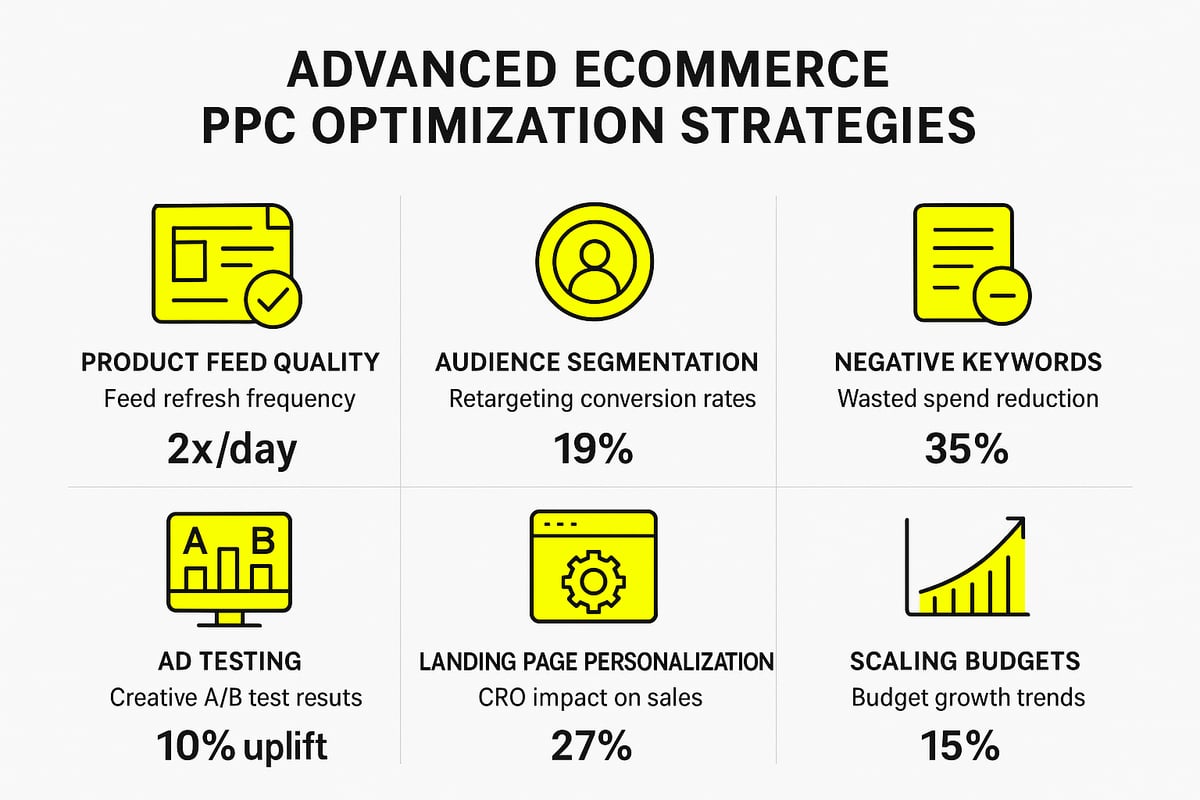
A high-quality product feed is the backbone of ecommerce ppc management. Start by scheduling daily feed refreshes to ensure real-time pricing and inventory data. Weekly checks for disapprovals prevent ads from dropping out of auctions.
Each month, analyze performance by product category to spot trends and identify underperformers. Quarterly, restructure your feed to align with new launches or shifting business priorities. For example, a home and living retailer boosted Shopping Ads efficiency by fixing feed errors and updating product categories. Strong feeds consistently lower CPCs and increase ad relevance, making your ecommerce ppc management more effective.
Audience Targeting, Segmentation, and Remarketing
Sophisticated audience strategies are essential for ecommerce ppc management. Build custom audiences based on recent product views, past purchases, or cart abandonment events.
Segment these audiences by customer lifetime value, frequency, or even demographics. For instance, a beauty brand increased conversions by retargeting cart abandoners with personalized product ads across Google Ads, Meta, and TikTok. Industry averages show that retargeted users are 70 percent more likely to convert, so prioritize remarketing lists in your ecommerce ppc management playbook.
Negative Keyword Management and Budget Protection
Protecting your budget is a critical part of ecommerce ppc management. Establish a tiered negative keyword structure at the account, campaign, and ad group levels.
Review search term reports weekly to add new negatives, blocking irrelevant queries that drain spend. Prevent campaign cannibalization by ensuring negatives do not overlap between campaigns. For example, a fashion retailer reduced wasted spend by excluding terms like “free samples.” Effective negative keyword management can cut wasted spend by up to 30 percent, improving the profitability of your ecommerce ppc management.
Ad Creative and Extension Testing
Continuous ad testing is a pillar of ecommerce ppc management. Run A/B tests on headlines, descriptions, and calls to action to find combinations that drive higher engagement.
Rotate creatives to avoid ad fatigue and experiment with different extensions—such as price or promotion—to see which resonates best. A health brand recently increased CTR by testing “Shop Now” versus “Discover More.” Ongoing creative testing can deliver a 15 to 30 percent lift in CTR, keeping ecommerce ppc management campaigns fresh and effective.
Landing Page Personalization and CRO
Maximize conversion rates by personalizing landing pages for different audience segments within your ecommerce ppc management. Use dynamic content or product recommendations based on the ad group or user behavior.
Run split tests on layouts, images, and CTAs, and leverage heatmaps or session recordings to understand user behavior. A lifestyle brand saw a 50 percent sales increase after implementing personalized offers. For deeper insights and actionable tactics, explore these conversion rate optimization strategies to amplify your ecommerce ppc management outcomes.
Scaling Budgets and Campaigns Based on Data
Scaling in ecommerce ppc management is a data-driven process. Identify your top-performing products, keywords, and audiences using regular performance reviews.
Gradually increase budgets for high-ROAS campaigns, and expand into new markets or platforms once benchmarks are met. For instance, after strong results, a fashion brand scaled TikTok Ads to reach new customer segments. Use automation or scripts for bid adjustments, enabling your ecommerce ppc management to grow efficiently without losing control over spend or profitability.
Data-Driven Measurement, Reporting, and Continuous Improvement
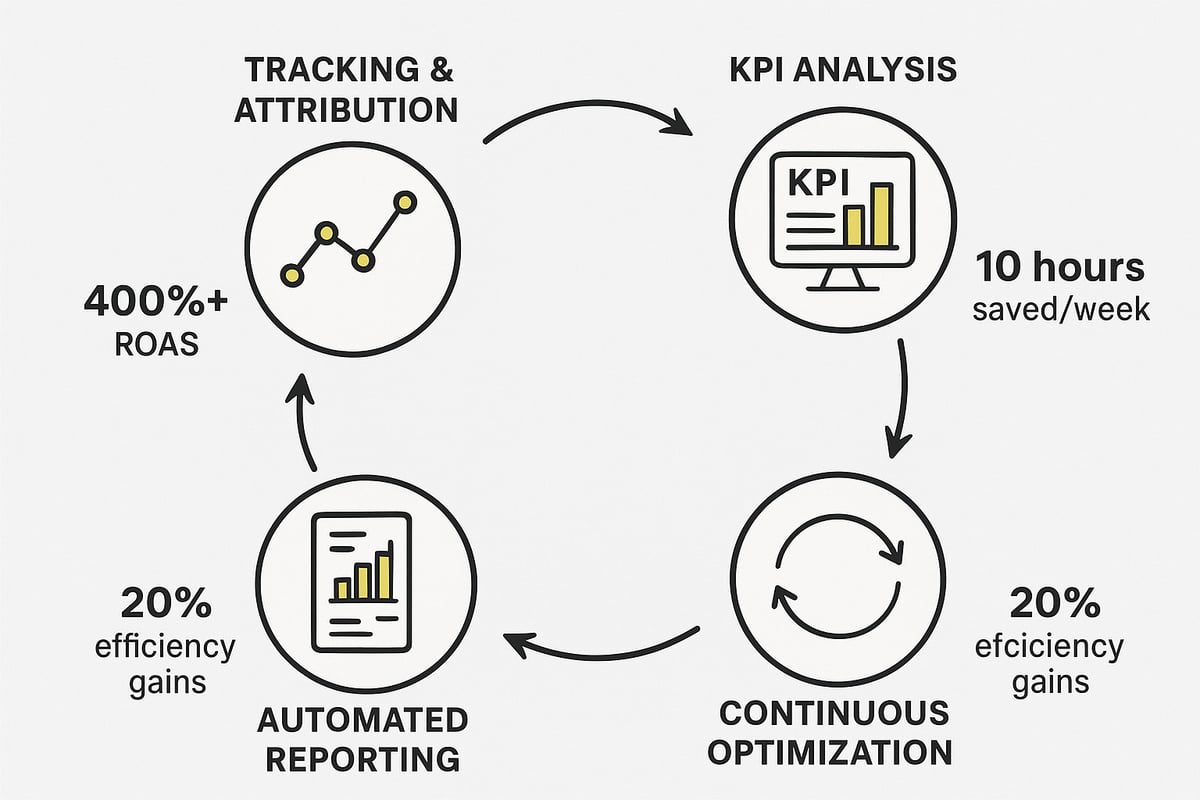
In the world of ecommerce ppc management, data-driven decision making is the foundation for sustainable growth. Brands that excel at tracking, analyzing, and acting on campaign data consistently outperform their competitors. The following four-step process ensures your PPC efforts remain profitable and scalable.
Setting Up Robust Tracking and Attribution
Start by implementing comprehensive tracking across all ecommerce ppc management touchpoints. Deploy Google Analytics 4, ad platform pixels, and server-side tagging to capture every conversion event. Use UTM parameters for granular source and campaign identification.
For example, a beauty retailer can track cross-device conversions by integrating Google Analytics 4 with Meta and TikTok pixels. This setup allows full-funnel insight, from ad click to final purchase, even if a customer switches devices.
Key steps:
- Enable enhanced conversions for accurate order attribution.
- Test event tracking with real purchases before scaling.
- Audit tags monthly to prevent data loss.
- Align tracking with business objectives, such as new customer acquisition.
Brands with advanced attribution frameworks report up to 20% higher marketing efficiency. Reliable data is the backbone of effective ecommerce ppc management and powers every optimization decision.
Analyzing KPIs: ROAS, MER, LTV, and Beyond
With tracking in place, focus on analyzing key performance indicators that matter for ecommerce ppc management. Prioritize metrics like ROAS (Return on Ad Spend), cost-per-acquisition (CPA), conversion rate, and average order value (AOV).
Home decor brands, for instance, often shift budgets to campaigns with the highest LTV (lifetime value) segments, not just the lowest CPA. Calculate your Marketing Efficiency Ratio (MER) to understand overall spend versus revenue.
Table: Essential Ecommerce PPC KPIs
| Metric | What It Measures | Why It Matters |
|---|---|---|
| ROAS | Revenue per ad dollar | Core profitability metric |
| CPA | Cost per conversion | Budget allocation decisions |
| LTV | Long-term customer value | Informs bidding, segmentation |
| MER | Total spend efficiency | Tracks marketing effectiveness |
High-performing ecommerce ppc management teams benchmark at 400%+ ROAS, enabling reinvestment and rapid scaling. Always tie KPIs back to business goals for meaningful analysis.
Reporting and Actionable Insights
Automated, real-time reporting is crucial for ecommerce ppc management success. Build dashboards segmented by product, channel, audience, and device to quickly spot trends and anomalies.
For example, a lifestyle brand can use automated dashboards to identify which products drive the highest ROAS on Google Shopping versus Meta Ads. This enables rapid budget reallocation and prevents wasted spend.
Action steps:
- Set up weekly performance reports for all stakeholders.
- Use visualization tools to highlight underperforming areas.
- Integrate AI-powered analytics tools for deeper insights, as explained in How to use AI in ecommerce.
- Schedule monthly report reviews to inform strategy pivots.
Automated reporting saves ecommerce ppc management teams up to 10 hours per week, freeing time for high-impact activities.
Continuous Optimization Cycles
The final step in ecommerce ppc management is building a culture of continuous improvement. Create weekly and monthly optimization sprints to test new keywords, creatives, and landing pages. Pause or adjust underperforming campaigns quickly to avoid wasted budget.
A fashion retailer, for example, runs monthly creative refresh cycles, testing new ad copy and visuals to combat ad fatigue. Use tools and scripts to automate bid adjustments and feed updates, ensuring campaigns stay competitive.
Stay ahead by:
- Regularly reviewing search queries for negative keyword opportunities.
- Rotating creatives and testing different ad extensions.
- Leveraging AI-powered campaign management, which is becoming the industry standard as highlighted in AI-powered campaign management becomes the default.
Encourage experimentation and learning at every level. Ecommerce ppc management thrives on agility, data, and a relentless pursuit of better performance.
Future-Proofing Your Ecommerce PPC Strategy: Trends and Predictions for 2026
Staying ahead in ecommerce ppc management means anticipating shifts before they disrupt your campaigns. As 2026 approaches, new technologies, privacy regulations, and evolving consumer behaviors are reshaping the landscape. Forward-thinking brands that adapt to these trends will secure lasting competitive advantages.
AI and Automation in PPC Management
AI is transforming ecommerce ppc management by streamlining campaign setup, bid optimization, and creative generation. Brands can use AI tools to automatically adjust bids, allocate budgets, and generate ad variations based on real-time performance data. For example, a beauty retailer leveraging Google’s Performance Max saw omnichannel sales rise by 30% after automating feed updates and creative testing.
To implement AI:
- Enable automated bidding in Google Ads and Microsoft Advertising.
- Use scripts or third-party platforms for daily feed refreshes.
- Test AI-powered creative tools for ad copy and design.
With global search ad spend projected at $190.5B in 2024, automation is essential for efficiently scaling ecommerce ppc management.
Privacy, Attribution, and First-Party Data
Privacy regulations are changing how ecommerce ppc management operates. With cookies being phased out, brands must shift to first-party data and transparent consent practices. Fashion and lifestyle brands are growing their email and SMS lists to create reliable retargeting audiences.
Action steps include:
- Implement server-side tagging and enhanced conversions.
- Collect consented customer data via loyalty programs.
- Use Google Analytics 4 for advanced attribution.
A home & living retailer improved campaign accuracy by integrating first-party purchase data, ensuring ecommerce ppc management aligns with privacy standards and delivers actionable insights.
Omnichannel and Cross-Platform PPC Integration
Consumers interact with brands across multiple touchpoints, making omnichannel ecommerce ppc management vital. Leading brands synchronize campaigns on Google, Meta, TikTok, and Pinterest to deliver consistent messaging and maximize reach. For example, a home decor company launched a new collection using Google Shopping and Instagram Ads, resulting in a 25% higher ROAS.
To achieve seamless integration:
- Align creative across search, social, and shopping channels.
- Use unified tracking for cross-platform attribution.
- Coordinate promotions and product launches by channel.
The global ecommerce market projected to reach $6.86 trillion in 2025 highlights the scale of opportunity for brands mastering omnichannel ecommerce ppc management.
Preparing for Emerging Platforms and Ad Formats
Emerging platforms and innovative ad formats are unlocking new growth channels for ecommerce ppc management. TikTok, Pinterest, and retail media networks offer shoppable video, live commerce, and AR ads. Health and wellness brands piloting TikTok Shop have seen rapid sales growth from interactive content.
Key steps to stay ahead:
- Monitor new ad formats regularly.
- Test shoppable video and live commerce with select products.
- Optimize campaigns for mobile, as mobile devices account for 52% of total PPC clicks as of 2025.
Agility in adopting these innovations ensures your ecommerce ppc management remains future-ready and competitive.
As you explore the evolving landscape of ecommerce PPC for 2026, it becomes clear that balancing creative branding with data-driven performance is no longer optional—it’s essential for scalable, sustainable growth. If you’re ready to align your PPC strategy with your business goals and take advantage of the latest trends and platform insights, we’re here to help. At Good Karma Agency, we combine deep creative expertise with advanced analytics to deliver results that matter—higher ROAS, seamless brand integration, and rapid execution across every channel. Want to discuss how we can accelerate your ecommerce growth together
Contact us


