
The ecommerce landscape is shifting faster than ever, challenging brands to rethink how they operate, engage, and grow. Are you prepared to unlock new opportunities and stay ahead of competitors in 2026?
This ecommerce inside guide delivers a practical roadmap for success. Discover the proven strategies, innovative technologies, and forward-thinking mindsets that top brands in fashion, beauty, lifestyle, and home are using to thrive. We break down emerging trends, showcase real-world examples, and reveal how data, AI, and customer experience innovations can fuel your growth.
Get ready to explore actionable steps and expert insights to future-proof your ecommerce business for the next era.
The 2026 Ecommerce Landscape: Trends & Disruptors
The pace of change in ecommerce inside the global market is staggering. By 2026, leaders across fashion, beauty, lifestyle, and home are facing a landscape where innovation is the only constant. This section breaks down the trends and disruptors you need to know, with real-world examples and actionable insights to help your ecommerce inside journey thrive.
The Blurring Lines Between B2B and B2C
B2B and B2C are converging faster than ever. B2B buyers now expect the same seamless, intuitive digital experiences they find in top D2C brands. Self-service portals, personalized recommendations, and frictionless checkouts are becoming baseline expectations.
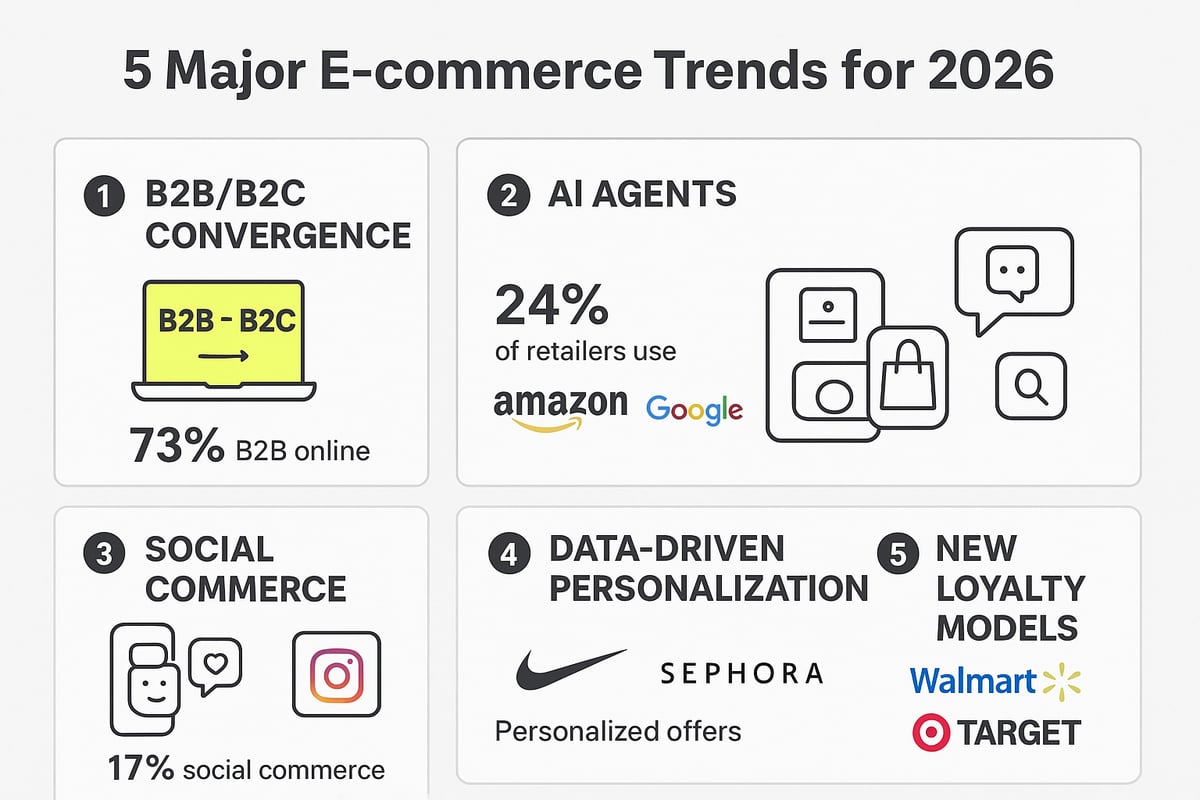
Fashion wholesalers are a prime example. Many have overhauled their ecommerce inside strategies, adopting D2C-style UX and streamlined checkout flows. According to Inside Commerce (2025), 73% of B2B buyers now prefer purchasing online.
To adapt, brands must rethink segmentation. Map customer journeys to deliver consumer-grade experiences, regardless of buyer type. Start by reviewing your UX and offering tailored portals for each segment.
AI, Agentic Commerce, and Automation
AI is compressing the sales funnel and transforming ecommerce inside operations. Agentic commerce, where AI agents drive recommendations, support, and even checkout, is becoming mainstream. Tools like Shopify’s Sidekick AI automate merchant support and workflows, freeing up time and boosting efficiency.
Top retailers have reported a 30% increase in conversion rates with AI-powered tools (Inside Commerce, 2025). To stay ahead, audit your processes for automation potential and integrate AI into customer touchpoints. For a deeper dive into practical AI applications, see How to Use AI in Ecommerce.
Start with a small pilot: automate product recommendations or FAQs, then scale as you see results.
Social Commerce and New Points of Purchase
Ecommerce inside is no longer confined to your website. Social commerce is booming, with platforms like TikTok and Instagram becoming high-converting sales channels. Instant checkout directly from social feeds is now standard, especially for younger demographics.
Beauty brands are leading the charge, launching viral product campaigns on TikTok Shop. In 2025, social commerce accounted for 17% of global ecommerce sales. To capitalize, diversify your sales strategy: enable shoppable posts, sync inventory across channels, and prioritize mobile-first content.
Begin by identifying your top-performing social platforms, then test direct checkout integrations to reduce friction.
The Rise of Data Intelligence and Personalization
Data is the backbone of modern ecommerce inside success. Brands using advanced analytics tools such as Northbeam and Triple Whale can track profitability, customer lifetime value, and campaign attribution with precision.
Home and living brands are leveraging AI to create personalized product bundles, driving up average order value. In fact, retailers using advanced personalization saw a 21% increase in AOV (Inside Commerce, 2025).
Action steps: centralize your customer and sales data, invest in analytics, and use insights to tailor every touchpoint. Prioritize data quality and regular audits for best results.
New Customer Loyalty Models and Cross-Border Challenges
Customer loyalty is evolving. The traditional points-based approach is giving way to value-driven programs focused on experiences and community. Leading lifestyle brands now offer experiential rewards, like exclusive events or early access, to deepen engagement.
Cross-border ecommerce inside growth brings new challenges, from tariffs to complex logistics. Brands must adopt agile, tech-driven solutions to remain competitive. According to Inside Commerce (2025), 62% of consumers prefer loyalty programs with experiential perks.
To future-proof your business, innovate your loyalty model and invest in scalable logistics tech. Start by surveying your audience to discover which perks matter most, then build your program around those insights.
Building a Future-Proof Ecommerce Strategy
Creating a future-proof ecommerce inside strategy requires a proactive approach and constant alignment with emerging trends. Use these five concrete steps to ensure your business is ready for the demands of 2026.
Step 1: Audit and Align Your Brand & Tech Stack
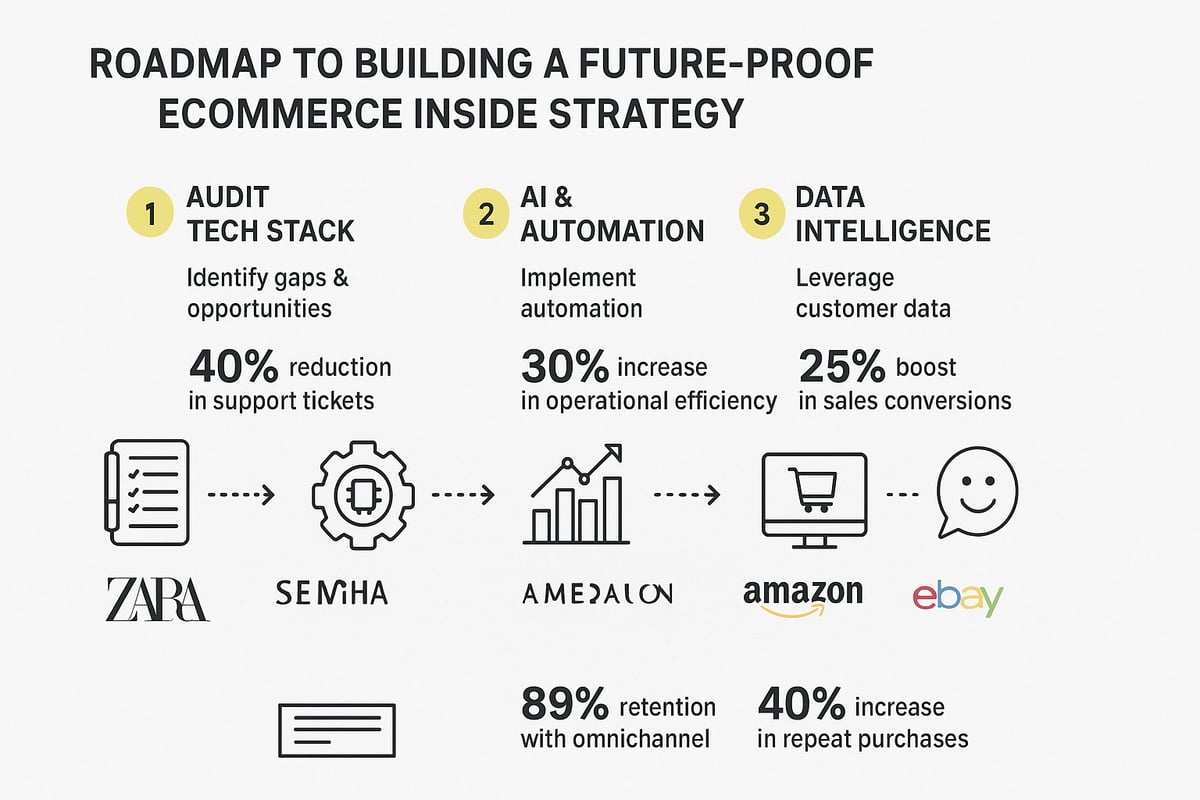
Begin your ecommerce inside transformation with a comprehensive audit. Evaluate if your brand identity resonates with current consumer expectations, especially as digital experiences evolve. Review your ecommerce platform—does it support mobile-first design, security, and global scalability?
For instance, a fashion retailer migrating to Shopify Plus unlocked seamless international expansion and faster site speed. Use this checklist:
- Is your UX/UI intuitive and accessible?
- Is your site mobile-optimized?
- Are speed, security, and compliance up to date?
Regular audits help you uncover gaps and prioritize improvements. For actionable strategies, explore Low-Cost, High-Return Tactics that elevate your tech stack efficiently.
Step 2: Integrate AI & Automation for Efficiency
Identify manual processes within your ecommerce inside operations that can be automated. Start by mapping repetitive tasks—inventory management, support inquiries, and personalized recommendations.
Consider a health and wellness brand that implemented AI chatbots for subscription management, reducing manual support tickets by 40%. Introduce AI-driven product recommendations to streamline customer journeys and boost conversion rates.
Practical steps:
- Deploy AI chatbots for 24/7 support.
- Automate inventory and order workflows.
- Integrate product recommendation engines.
Efficiency gains free up your team to focus on growth and innovation, keeping your ecommerce inside business agile.
Step 3: Leverage Data for Smarter Decisions
Centralize and clean your data to create a single source of truth for ecommerce inside metrics. Modern analytics tools such as Northbeam or Triple Whale provide deep insights into attribution, lifetime value (LTV), and customer acquisition cost (CAC).
For example, a beauty brand used Northbeam’s 30-day impression data to refine its marketing spend and boost ROI. Key actions include:
- Audit data integrity and privacy compliance.
- Build actionable dashboards for real-time insights.
- Schedule regular data reviews across teams.
Data-driven decision making empowers you to optimize campaigns, personalize offers, and drive profitability in ecommerce inside.
Step 4: Diversify Sales Channels and Points of Purchase
Expand your ecommerce inside reach by selling beyond your website. Social commerce, marketplaces, and direct checkout from ads are now mainstream. Sync inventory and customer data across all channels for a unified view.
A D2C furniture brand saw higher retention after launching on Instagram Shop and Pinterest. Here’s a checklist:
- Activate social commerce (TikTok, Instagram Shop).
- Integrate with major marketplaces.
- Ensure inventory sync and consistent customer data.
Brands with an omnichannel presence enjoy up to 89% higher customer retention, making diversification essential for future-proofing ecommerce inside.
Step 5: Innovate Customer Experience and Loyalty
Deliver frictionless, personalized journeys at every ecommerce inside touchpoint. Move beyond traditional points-based loyalty programs to offer community, content, and exclusive experiences.
An apparel brand recently launched members-only events and early product drops, increasing engagement among Gen Z. To strengthen loyalty:
- Personalize content and offers across devices.
- Build brand communities with exclusive perks.
- Host events for early access and VIP treatment.
Sixty percent of Gen Z shoppers join brand communities for exclusivity, proving that innovation in experience and loyalty is critical for ecommerce inside success.
AI, Agentic Commerce, and the Evolution of Search
Artificial intelligence is transforming how brands and consumers interact, discover, and convert. The ecommerce inside perspective for 2026 is clear: AI is not just a trend, but a foundational shift that will define success for forward-thinking retailers. As agentic commerce and automation mature, the entire buying journey is being streamlined, personalized, and optimized for speed and satisfaction.
How AI is Reshaping Discovery and Conversion
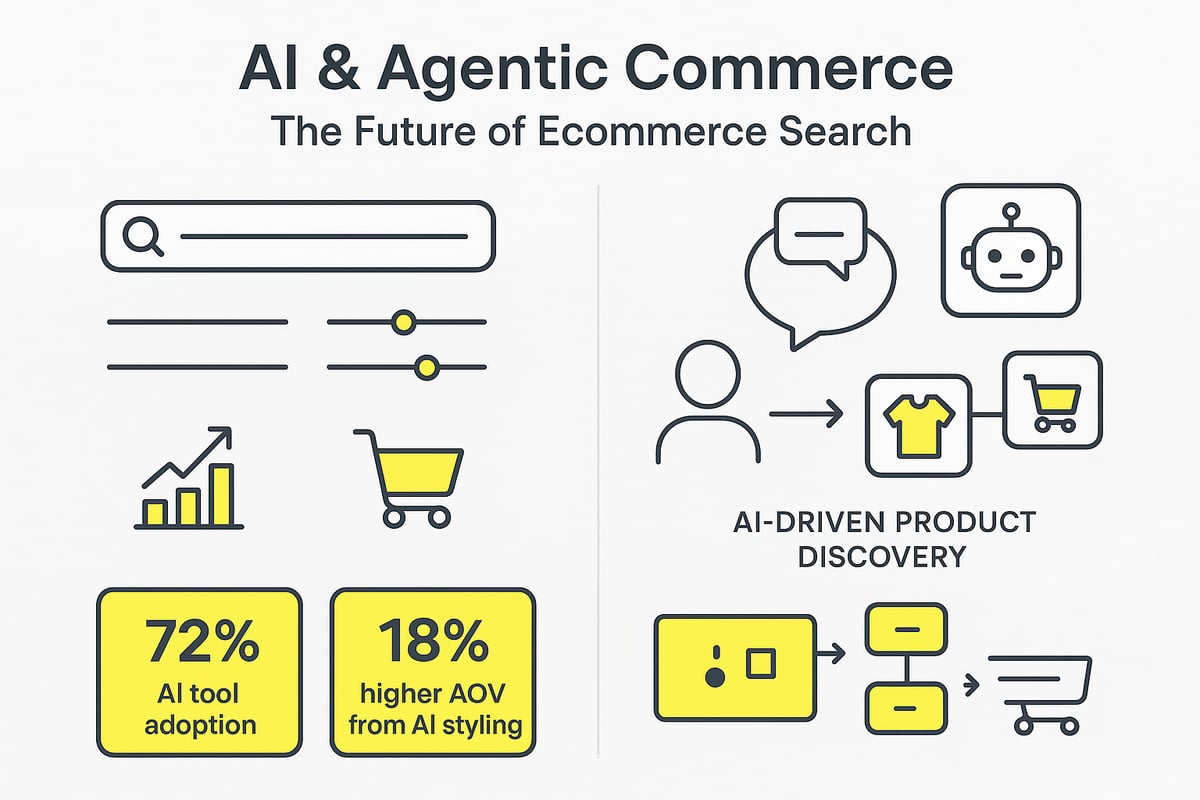
The ecommerce inside journey is moving rapidly from search-led to answer-led discovery. Instead of customers typing queries, AI now anticipates intent and suggests relevant products or bundles. AI agents curate options, configure complex products, and compare alternatives instantly.
For example, Elastic Path’s Product Experience Manager enables B2B brands to serve tailored catalogs to different buyers, speeding up decision-making. In fashion, AI-powered recommendation engines surface trending looks based on browsing behavior. This approach compresses the sales funnel, leading to faster conversions and fewer abandoned carts.
By shifting from passive search to active suggestion, companies unlock higher engagement and conversion rates.
Practical Steps to Implement Agentic Commerce
To bring ecommerce inside the AI-driven future, brands should start by pinpointing customer pain points. Where do shoppers struggle or drop off? Common areas include product matching, FAQs, and checkout support.
Step-by-step implementation:
- Map out key touchpoints where AI can add value.
- Integrate agentic tools with your ecommerce stack (e.g., Shopify, Magento).
- Structure product and customer data for AI readiness.
- Train AI agents with real FAQs and product scenarios.
- Automate repetitive workflows, but monitor for quality.
For instance, Shopify’s Sidekick AI assists merchants by automating support and surfacing insights. A clear data structure and ongoing agent training are critical for sustainable results.
Case Studies: AI Success in Fashion, Beauty, and Lifestyle
Across the ecommerce inside landscape, real-world brands are reaping measurable benefits from AI. Fashion retailers use styling assistants powered by machine learning to increase average order value by 18 percent. Beauty brands deploy personalized skincare quizzes, doubling conversion rates. Lifestyle companies automate product bundling based on individual browsing habits.
A recent industry report found that 72 percent of top-performing brands had adopted at least one AI tool by 2025. According to AI Marketing Adoption by Industry, retail and ecommerce sectors will reach a 76 percent adoption rate in 2026. These statistics underscore that AI-powered tools are now essential for staying competitive.
Pitfalls and How to Avoid Them
Despite the promise of AI, ecommerce inside strategies can falter without careful planning. Poor data quality leads to irrelevant recommendations, frustrating users. Over-automation risks making experiences feel impersonal, which can erode brand trust.
Avoid these pitfalls by:
- Conducting regular data audits to ensure accuracy.
- Balancing automation with curated, human-led touchpoints.
- Collecting user feedback to fine-tune AI recommendations.
- Training staff to oversee and optimize agentic workflows.
The winning formula pairs advanced AI with authentic brand experiences, creating a seamless, trustworthy journey for every customer.
Data Intelligence, Measurement, and Performance Marketing
Understanding data intelligence is at the heart of ecommerce inside success for 2026. Brands that master measurement frameworks, team alignment, and performance marketing are set to outperform their competitors. Let us break down each step with actionable strategies and real-world examples.
The New Measurement Framework for 2026
The ecommerce inside approach now centers on multi-touch attribution, moving beyond last-click models. Advanced tools like Triple Whale and Northbeam give brands a granular view of customer journeys.
For example, a home and living retailer used geo-based testing and saw a 25% lift in marketing ROI. To implement this framework:
- Map every customer touchpoint, from first ad to repeat purchase.
- Integrate analytics platforms for unified reporting.
- Use A/B testing to validate channel effectiveness.
Brands using these strategies see stronger insights and smarter spend. Measurement is no longer static, it is dynamic and predictive for ecommerce inside leaders.
Aligning Teams Around Data and KPIs
Ecommerce inside success hinges on unified teams and shared metrics. Siloed data slows decisions and blurs accountability.
Take the case of a lifestyle brand: by integrating sales and marketing dashboards, everyone tracked LTV and CAC in real time. Here is how to align your teams:
- Set cross-functional KPIs: LTV, CAC, repeat rate, profit per order.
- Schedule regular data review meetings.
- Share dashboards across departments for transparency.
When teams align around data, ecommerce inside brands act faster and adapt to market shifts confidently.
Performance Marketing: Channel Diversification and Profitability
Performance marketing in ecommerce inside is no longer about chasing growth at any cost. Brands now focus on profitable growth by testing new channels and optimizing creative.
For example, a fashion brand achieved a 7x ROAS on Meta using full-funnel creative strategies. Explore channels like TikTok, Pinterest, and influencer partnerships.
| Channel | ROAS | Trend |
|---|---|---|
| Meta | 7x | High |
| TikTok | 5x | Rising |
| 4x | Growing |
According to the Profitable BFCM Ecommerce Guide, 50% of brands increased ad spend on emerging channels in 2025. Diversification is a must for ecommerce inside resilience.
Leveraging Third-Party Tools and Automation
Automation empowers ecommerce inside brands to scale efficiently. Top performers automate reporting, segmentation, and creative testing.
A beauty brand, for instance, used email automation to boost abandoned cart revenue by 326%. To get started:
- Integrate tools like Klaviyo for email and Shopify Flow for workflow automation.
- Build automation playbooks for recurring tasks.
- Schedule regular optimization reviews.
Check for seamless tool integration and always prioritize actionable dashboards. With the right setup, ecommerce inside brands gain speed, accuracy, and a competitive edge.
Platform Innovation: Choosing and Optimizing Your Tech Stack
The ecommerce inside world is transforming rapidly as platforms invest in AI, APIs, and flexible architectures. Brands in fashion, beauty, and lifestyle must stay ahead by choosing systems that support innovation. Headless commerce is gaining traction, letting brands launch custom storefronts with global reach and lightning-fast load times. For example, a homeware retailer adopted a headless setup to serve customers in multiple countries with local currencies and content.
The Evolution of Ecommerce Platforms
Ecommerce inside strategies now require platforms that are agile and scalable. Shopify, BigCommerce, and Centra are leading by embedding AI features, open APIs, and modular services. For instance, many lifestyle brands have moved to these platforms for faster launches and better integrations. Headless commerce lets teams decouple the frontend from the backend, building unique brand experiences without sacrificing site speed. In 2026, 43% of mid-market brands plan to replatform, choosing solutions that fit their growth plans.
Customization vs. Speed: Finding the Balance
Brands face a common ecommerce inside dilemma: opt for mass-market platforms or build niche, custom solutions. Using tactical middleware like Airtable or SuperBase can bridge gaps quickly, letting brands test new features without a full rebuild. For example, an apparel retailer integrated a custom checkout flow using middleware to boost conversions. When evaluating options, weigh business needs, budget, scalability, and in-house expertise. For checkout innovation, see Shopify's One-Page Checkout Guide for actionable insights.
Vendor Insights: What Leading Platforms Are Prioritizing
Ecommerce inside leaders are prioritizing developer experience, powerful AI, and robust ecosystem integrations. Shopify’s Catalogs API and Pulse enable brands to democratize data and run faster experiments. According to recent data, 67% of brands rate platform ecosystem as their top selection factor. Real-world example: a beauty brand leveraged Shopify’s ecosystem to launch rapid A/B tests and streamline their product catalog, leading to higher agility and faster go-to-market cycles.
Migration and Expansion: Best Practices
Successful migration in ecommerce inside means detailed planning. Start with a migration roadmap that covers data transfer, SEO preservation, and phased rollouts. For global expansion, ensure multi-currency support and local compliance. A beauty brand migrating to Shopify Plus achieved a seamless multi-country launch by aligning stakeholders, auditing SEO, and executing in phases. Key checklist items: data integrity, SEO audit, staging environments, and user training to minimize disruption.
Why Work with a Specialist Ecommerce Agency?
Partnering with a specialist ecommerce inside agency like Good Karma Agency brings expertise in Shopify design, development, and performance marketing. Brands have seen a 50% increase in conversion rates and 7x ROAS through end-to-end support. Agencies offer rapid launches, data-driven optimization, and creative production for omnichannel growth. Trusted by leaders in fashion, lifestyle, and consumer goods, they ensure every tech stack decision drives measurable results.

Customer Experience and Loyalty in 2026
Delivering a standout customer journey is vital for ecommerce inside success in 2026. Consumer expectations are at an all-time high. Brands leading the way are those that create seamless, memorable, and loyal experiences across every touchpoint.
Designing Seamless, Omnichannel Journeys
Consistency is the foundation of exceptional ecommerce inside experiences. Customers expect to move smoothly between web, mobile, app, and social channels, never missing a beat.
| Channel | Key Feature | Example Brand |
|---|---|---|
| Web | AR product previews | Furniture retailer |
| Mobile | 1-click checkout | Beauty brand |
| App | Loyalty wallet | Fashion label |
| Social | Shoppable posts | Home & living store |
A homeware brand, for example, uses AR-powered previews on mobile so shoppers can visualize furniture in their space. To achieve this, brands should audit every touchpoint for UX consistency, synchronize inventory, and personalize content by channel.
Rethinking Loyalty: Value, Community, and Exclusivity
Loyalty in ecommerce inside is shifting beyond points and discounts. Today’s consumers crave meaningful rewards, exclusive access, and a sense of belonging.
Fashion brands now host members-only styling workshops, creating value through real-world experiences. Health and wellness companies offer VIP communities with early product drops and expert Q&A sessions. To build this, segment your audience, deliver experiential perks, and foster community with branded forums or exclusive events.
A recent study found 62% of shoppers prefer loyalty programs that offer experiential perks over traditional discounts. Brands succeeding in 2026 are those who turn loyalty into a lifestyle, not just a transaction.
Leveraging Content and Social Proof
Trust is currency in ecommerce inside. User-generated content (UGC), influencer collaborations, and authentic reviews fuel conversion and credibility.
A leading beauty brand, for example, integrates TikTok review videos directly onto product pages. This approach leverages social proof, helping hesitant buyers make confident decisions. Gen Z shoppers are especially motivated by influencer recommendations, with 71% trusting them over brand ads.
To maximize results, encourage customers to share their experiences, spotlight UGC on your site, and partner with relevant influencers. Curate shoppable content across channels to drive engagement and sales.
Proactive Support and Post-Purchase Experience
Support is no longer just reactive. In ecommerce inside, proactive, AI-powered service is a game changer. Brands now automate post-purchase care emails, send restock alerts, and provide instant order tracking.
According to AI Shopping Usage Statistics, 64% of consumers plan to use AI chatbots for shopping by 2026. Home and living brands are adopting these tools to resolve inquiries quickly, reducing wait times and boosting satisfaction.
To replicate this, deploy chatbots for FAQs, automate routine updates, and monitor feedback for continuous improvement. Brands with proactive support see 25% higher repeat purchase rates, cementing customer loyalty for the long term.
As you look ahead to 2026, it’s clear the ecommerce landscape is evolving rapidly—from AI-driven automation and data-powered personalization to seamless omnichannel experiences and innovative loyalty models. Navigating these changes can be complex, but you don’t have to do it alone. At Good Karma Agency, we specialize in blending creative brand-building with measurable performance, helping fast-growing brands stay ahead of the curve. If you’re ready to future proof your ecommerce strategy and unlock new growth, let’s start a conversation.
Contact us
and discover how we can help your brand thrive in the next era of ecommerce.
Article written using RankPill.


