
Are you struggling to decode digital marketing agency pricing in 2026? You are not alone. As ecommerce and DTC brands face a rapidly changing landscape, understanding what drives agency costs has become more complex than ever.
This guide delivers a clear, data-driven approach to digital marketing agency pricing, so you can budget confidently and maximize your return on investment. We will break down the latest pricing models, major cost drivers, typical service rates, budgeting steps, and how to select the right agency for your goals.
Get ready to unlock the secrets of agency pricing in 2026. With industry benchmarks and actionable strategies, you will gain the clarity needed to make smarter marketing investments this year.
Understanding Digital Marketing Agency Pricing Models in 2026
Digital marketing agency pricing has evolved rapidly, with brands facing more choices than ever before. Understanding how agencies charge in 2026 is critical for making smart investments and avoiding hidden costs that eat into your ROI. Let’s break down the core pricing models, what’s included in agency fees, and the main factors driving costs.
Hourly, Retainer, Project-Based, and Performance Pricing
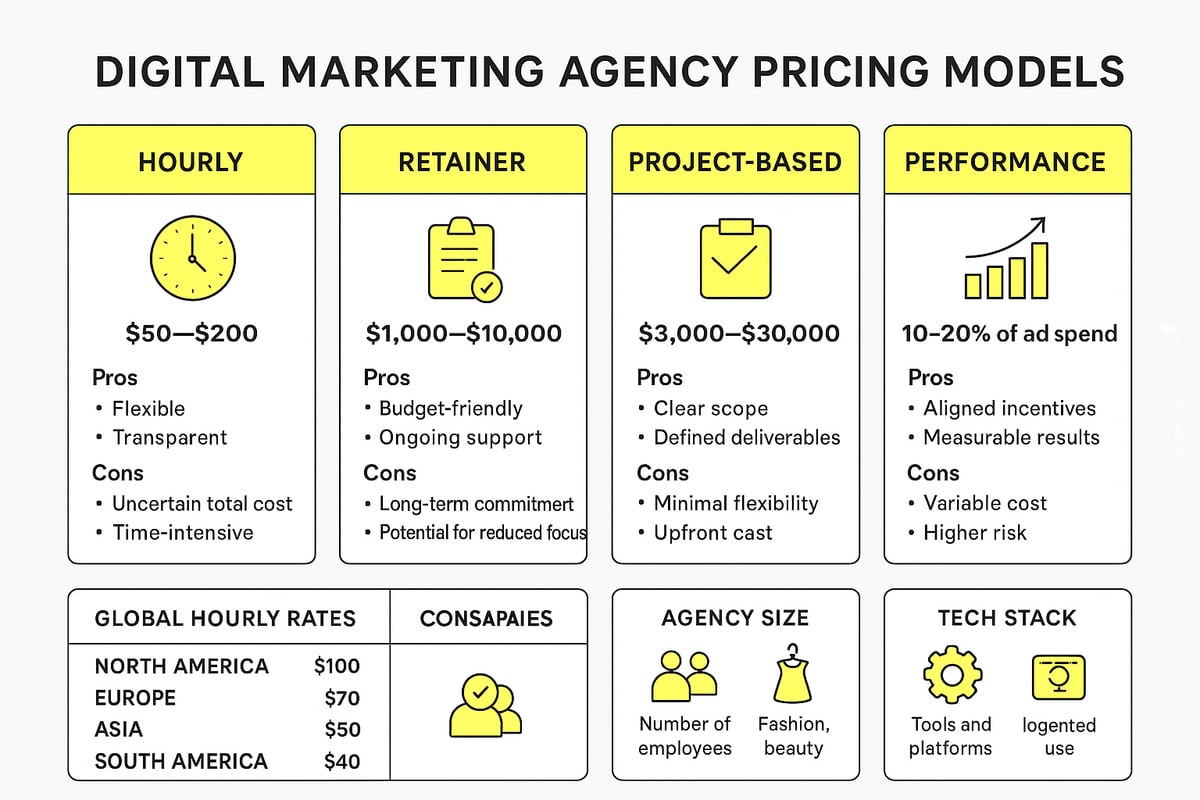
Digital marketing agency pricing typically falls into one of four models: hourly, retainer, project-based, or performance-based. Each structure fits different business needs and growth stages.
- Hourly rates: Agencies charge per hour, with fees ranging from $25 to $200+ depending on expertise and region. Clutch reports most agencies charge $25–$49 per hour globally, while US and UK shops often exceed $100 per hour.
- Monthly retainers: The most common for ongoing work, retainers range from $2,000 to $20,000+ per month. A boutique fashion brand might invest $3,000 monthly for always-on support, benefiting from predictable spend and dedicated resources.
- Project-based: Used for website launches, migrations, or campaigns, project-based fees vary from $3,000 to $50,000+. Health and wellness startups often choose this model for one-off initiatives like a Shopify site build.
- Performance-based: Payment is tied to measurable results such as leads, conversions, or revenue share. This model aligns agency incentives with your outcomes, but may require a higher minimum spend or longer commitment.
Here’s a summary table for easy comparison:
| Model | Typical Range | Best For | Pros | Cons |
|---|---|---|---|---|
| Hourly | $25–$200+/hr | Short tasks, flexible projects | Pay for actual work | Harder to budget |
| Retainer | $2,000–$20,000+/month | Ongoing partnerships | Predictable costs | May pay for unused hours |
| Project-Based | $3,000–$50,000+ | Website builds, campaigns | Defined deliverables | Scope creep risk |
| Performance-Based | % of results/CPA/revenue | ROI-driven campaigns | Aligns goals | Complex to track, variable |
For a deeper dive into how agencies structure these models, see the digital agency pricing models.
What’s Included (and Not Included) in Agency Fees
When reviewing digital marketing agency pricing, it’s crucial to distinguish between service fees and ad spend. Agency charges cover strategy, management, and creative work, but actual ad costs for Meta, Google, or TikTok are billed separately.
For example, a lifestyle brand might pay $5,000 per month for a retainer, covering content, reporting, and campaign management. On top of this, they allocate $10,000 per month for ad spend directly to platforms. Most agencies exclude these ad costs from their invoices, so brands must budget accordingly.
Add-ons like analytics dashboards, advanced reporting, conversion rate optimization, or creative production can increase your monthly bill. Always review proposals for clarity on what’s included and request itemized breakdowns.
Digital marketing agency pricing can also vary if you require additional services, such as influencer management or custom integrations. Industry data confirms that digital marketing fees usually exclude paid media spend, making it essential to plan your total investment up front.
Factors That Influence Agency Pricing
Several variables impact digital marketing agency pricing in 2026, beyond just the services you select.
- Agency size and reputation: Established agencies with a strong brand charge premium rates. Boutique or specialist agencies may offer more value for niche brands.
- Location: US, UK, and Australia agencies average $100–$149/hr, while agencies in India or the Philippines often charge $25–$49/hr for similar services.
- Industry complexity: Regulated sectors like health or beauty command higher fees due to compliance needs. Fashion and lifestyle brands might pay more for creative talent and influencer access.
- Scope of work: Multi-channel campaigns and international rollouts cost more than single-channel or local projects. For instance, a home and living brand launching in multiple countries on Shopify Plus could face project fees above $40,000.
- Tech stack: Leveraging premium tools such as Shopify Plus, Klaviyo, or GA4 increases costs, as do custom integrations.
- Deliverables: Ongoing optimization and reporting, versus one-off campaigns, affect pricing structures.
According to Clutch, the average digital marketing project costs $10,000–$49,999, while full-service retainers typically fall between $2,000 and $20,000+ per month. Brands should carefully assess these factors when evaluating digital marketing agency pricing to ensure alignment with both budget and business goals.
Typical Service Rates and What You Get for Your Money
Understanding digital marketing agency pricing in 2026 is crucial for brands aiming to allocate budgets wisely and maximize ROI. Service costs vary widely, but knowing what you get for your investment helps you make informed, confident decisions.
Core Digital Marketing Services & Average 2026 Pricing
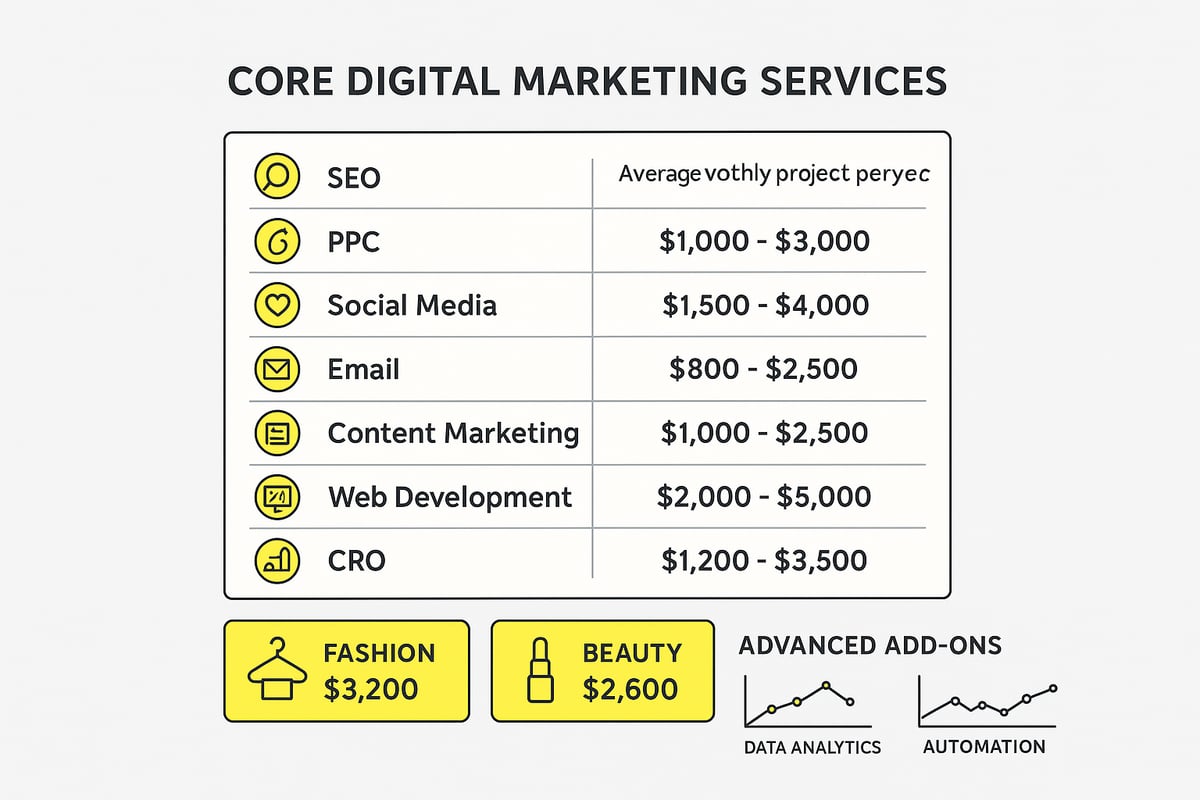
When evaluating digital marketing agency pricing, start with the core services most brands need. Here is a pricing snapshot for 2026:
| Service | Average Pricing (2026) | Typical Deliverables |
|---|---|---|
| SEO | $500–$5,000+/month | Audits, on-page, link building |
| PPC Management | $1,000–$10,000+/month | Ad setup, bidding, reporting |
| Social Media Management | $750–$6,000+/month | Content, posting, community mgmt |
| Email Marketing | $500–$4,000+/month | Segmentation, automation, creative |
| Content Marketing/Blog | $1,000–$8,000+/month | Copy, graphics, video |
| Web Design/Development | $3,000–$50,000+ per project | Shopify, WordPress, Webflow builds |
| CRO | $1,500–$10,000+/month | A/B tests, heatmaps, user analysis |
For example, a beauty brand might allocate $8,000 per month to content marketing and $3,000 to email, focusing on trust-building and engagement. A fashion label could spend $5,000 monthly on PPC for seasonal launches.
Keep in mind, digital marketing agency pricing does not include ad spend. If your lifestyle brand retains an agency for $5,000 per month, you may also budget $10,000 monthly for ads.
Agencies offer bundled services, but each core area has distinct deliverables. To compare rates and validate your budget, reference digital marketing agency pricing benchmarks for updated hourly and project data.
Advanced/Specialized Services & Value Add
As your brand grows, specialized services enhance your marketing mix and influence digital marketing agency pricing. Here is how advanced offerings can impact your investment:
- Marketing Automation: Automating email flows, CRM, and chatbots can add $2,000–$7,000 per month, depending on complexity.
- Influencer/Affiliate Marketing: Program setup, outreach, and management typically range from $3,000–$10,000 monthly. A fashion label launching a new collection may use this to amplify reach.
- Video Marketing: Scripting, editing, and YouTube optimization start at $2,500 per month. Beauty and wellness brands often invest here to showcase tutorials or testimonials.
- Reputation Management: Monitoring reviews and sentiment, essential for health and lifestyle brands, usually costs $1,500–$5,000 per month.
- Omnichannel Strategy: Integrating online and offline experiences, such as for home/living brands, can require $4,000–$12,000 monthly.
For instance, a home and living retailer planning a multi-country Shopify rollout may see project fees rise above $50,000 due to increased complexity and tech stack requirements.
These add-ons ensure your digital marketing agency pricing reflects not just the basics, but also the expertise needed for growth and compliance in regulated sectors.
Real-World Pricing Examples from Leading Sectors
Digital marketing agency pricing varies by industry and campaign scope. Here are sector-specific snapshots:
- Fashion: Direct-to-consumer brands often spend $10,000–$50,000 per month for full-funnel marketing, including content, social, and creative.
- Health/Wellness: Higher compliance and creative demands push monthly retainers to $12,000+.
- Home/Living: Large Shopify Plus builds can exceed $50,000 per project, especially for international ecommerce.
- Lifestyle: Social-first campaigns with user-generated content typically range from $5,000–$15,000 per month.
For example, Anna+Nina, a jewelry and fashion brand, invests in cross-channel performance marketing, leveraging content and influencer strategies to drive measurable results.
By understanding these benchmarks and real-world cases, you can set expectations for digital marketing agency pricing and confidently plan your next campaign.
Step-by-Step Guide to Budgeting for Digital Marketing Agency Success in 2026
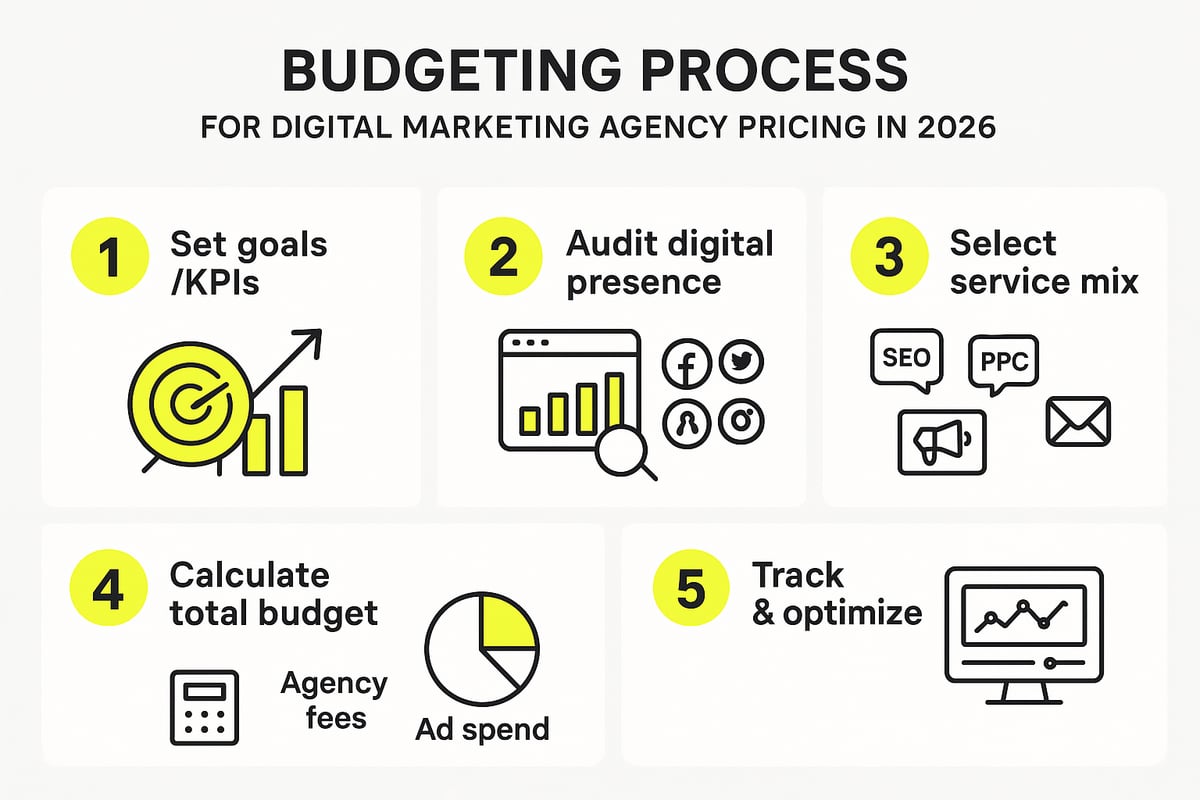
Budgeting for digital marketing agency pricing in 2026 requires a systematic approach. Following clear steps will help you allocate resources efficiently, avoid hidden costs, and maximize your marketing return. Use these five actionable steps to build a winning budget for your brand.
Step 1: Define Clear Marketing Goals & KPIs
Start your digital marketing agency pricing plan by setting specific business objectives. Are you aiming for higher traffic, more online sales, stronger brand awareness, or global market entry?
Choose measurable KPIs that align with these goals. Examples include return on ad spend (ROAS), conversion rate, customer acquisition cost (CAC), customer lifetime value (CLV), or improved organic search rankings.
For instance, a beauty brand might set a goal to triple their ROAS and increase conversion rates by 50 percent. Clear targets like these will guide your budget and agency discussions.
Step 2: Audit Your Current Digital Presence
Next, analyze your current digital assets and performance. Review your website, SEO rankings, paid advertising channels, email campaigns, and social media activity.
Compare your results against direct competitors in your sector. Use tools such as Google Analytics, Shopify analytics, or SEMrush to uncover strengths and weaknesses.
A home and living retailer might discover a low mobile conversion rate compared to industry benchmarks, highlighting a priority area for investment in digital marketing agency pricing.
Step 3: Choose the Right Service Mix for Your Needs
With goals and audit insights in hand, prioritize marketing channels that will drive the biggest impact for your industry and objectives. For some brands, SEO and PPC may be critical. For others, social media, email, or advanced services like conversion rate optimization (CRO) are essential.
Scaling health and wellness DTC brands often focus on content and email to build trust. Fashion startups may need paid social and influencer marketing to launch new collections. Explore the Digital marketing services overview to understand the scope and value of each service before finalizing your mix.
Step 4: Calculate Total Budget (Agency Fees + Ad Spend)
Now, estimate your full marketing investment. Factor in both agency fees and ad spend, as digital marketing agency pricing typically separates these costs.
Industry benchmarks suggest allocating two to three times your agency fee for ad spend. For example, a fashion ecommerce brand might budget 7,000 dollars per month for agency services plus 15,000 dollars monthly for ads. Remember to include extra costs for creative production, analytics tools, and platform fees.
A simple table to visualize your budget:
| Cost Component | Example Monthly Spend |
|---|---|
| Agency Fees | $7,000 |
| Ad Spend | $15,000 |
| Tools/Creative | $1,500 |
| Total | $23,500 |
Step 5: Track, Optimize, and Adjust
Finally, set up monthly reporting and analytics to track your digital marketing agency pricing ROI. Use dashboards to monitor KPIs, spot trends, and identify underperforming channels.
Regularly review results with your agency. Adjust budget allocations to focus on the highest-performing tactics. For example, a lifestyle brand might shift spend from Facebook to TikTok after seeing stronger engagement and lower cost per acquisition.
Continuous optimization ensures your investment delivers maximum value as your business evolves.
What Drives Price Differences: Key Cost Factors Explained
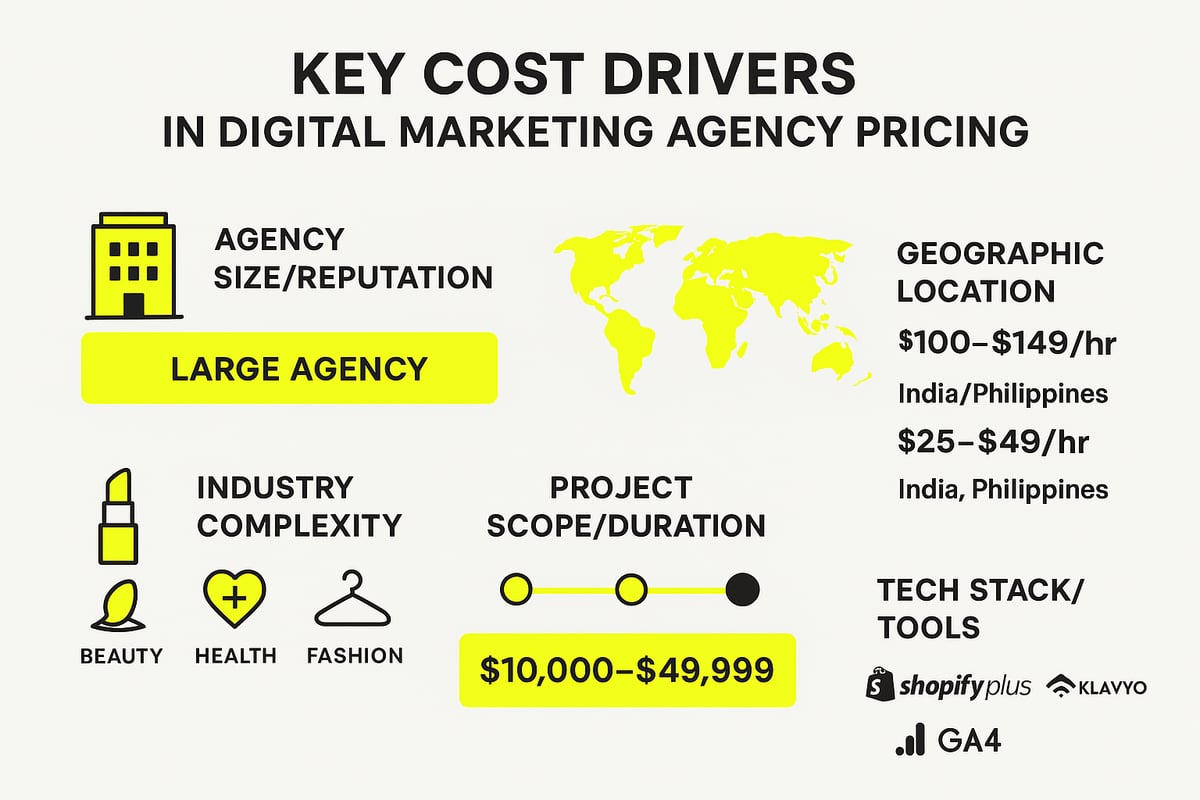
Understanding what causes digital marketing agency pricing to vary is crucial for brands seeking the right fit and value. From agency reputation to geographic location, industry complexity, project scope, and advanced tech tools, several factors combine to influence what you pay and what you get.
Agency Size, Experience, and Reputation
Agency size and track record are major influencers on digital marketing agency pricing. Large, award-winning agencies often command higher fees due to their established processes, access to senior talent, and recognizable client rosters. For example, a global agency supporting a fashion brand’s international launch may charge a premium for their expertise and portfolio.
In contrast, boutique or specialist agencies can offer more competitive rates, particularly for niche markets such as beauty or lifestyle. Fast-growing brands often choose boutique partners for their agility and personalized approach. To see how agency experience translates to real-world results and pricing, review Ecommerce case studies and results for examples across sectors.
Geographic Location and Labor Costs
Where an agency is based directly impacts digital marketing agency pricing. Agencies in the US, UK, and Australia typically charge $100–$149 per hour, reflecting higher labor and operating costs. Meanwhile, agencies in India or the Philippines may offer rates as low as $25–$49 per hour, making them attractive for budget-conscious projects.
Nearshore or offshore agencies can help brands save money, but it is important to consider time zones, communication, and cultural fit. For instance, a home and living brand might outsource web development to Poland at $50–$99 per hour, balancing cost and quality. For a deeper look at how region affects pricing, consult this global digital marketing industry report.
Industry Complexity & Regulatory Requirements
Industry-specific needs and compliance requirements can significantly raise digital marketing agency pricing. Sectors like beauty, health, and finance demand agencies with regulatory expertise and the ability to navigate complex legal standards. For example, a wellness brand requiring HIPAA-compliant email marketing will pay premium rates for that assurance.
Fashion and lifestyle brands may also see higher costs if campaigns require top-tier creative or influencer access. Always ensure your agency has relevant experience in your sector, as demonstrated by successful campaigns in regulated or creatively demanding industries.
Scope, Deliverables, and Campaign Duration
The breadth and depth of your project directly affect digital marketing agency pricing. Multi-channel, long-term campaigns cost more than single-channel, short-term projects. For example, a full-funnel launch for a new DTC beauty brand involving SEO, PPC, social, and email can push ongoing project costs into the $10,000–$49,999 range.
To maximize value, define your deliverables clearly and compare proposals across agencies. Brands in sectors like fashion or home and living often invest in comprehensive, multi-touchpoint campaigns to accelerate growth and market share.
Tech Stack, Tools, and Platform Fees
The technology and tools your agency uses add another layer to digital marketing agency pricing. Premium platforms like Shopify Plus, Klaviyo, and advanced analytics may increase monthly costs by $500–$2,000 or more. For example, a fashion brand investing in a Shopify Plus migration and Klaviyo automation will see these tech fees reflected in their overall budget.
Always ask agencies for a detailed breakdown of tech stack costs and how these investments support your goals. The right tools can drive measurable results, but transparency ensures you know exactly what you are paying for.
How to Choose the Right Digital Marketing Agency for Your Brand in 2026
Selecting the right partner is critical to maximizing your digital marketing agency pricing investment. As agency costs and service models evolve, a step-by-step approach will help you identify the best fit for your growth goals, sector, and budget.
Aligning Agency Capabilities with Your Business Goals
Start by mapping your objectives to agency strengths. If your ecommerce brand is focused on scaling revenue, seek agencies with proven expertise in performance marketing, CRO, or omnichannel strategies. For example, a beauty brand aiming for a 3x ROAS should shortlist partners with measurable results in that exact metric.
Ask for case studies that match your sector—fashion, home, lifestyle—so you can see relevant outcomes. Review their approach to specialized services, such as Performance marketing strategies or advanced content production. This ensures your digital marketing agency pricing aligns with the growth levers most critical to your brand.
Assessing Transparency, Communication, and Reporting
Clarity and communication are essential to getting full value from your digital marketing agency pricing. Insist on detailed proposals that outline deliverables, timelines, and costs. For ongoing campaigns, require regular updates—weekly or bi-weekly calls are standard among top agencies.
Request sample dashboards and reporting templates. A lifestyle brand, for example, may want weekly engagement reports across TikTok, Instagram, and Facebook. Transparent reporting helps you track ROI and adjust strategies quickly, so your investment stays on target.
Evaluating Portfolios, Case Studies, and Client Testimonials
A strong track record is a key indicator of agency value. Review portfolios with an eye for brands similar to yours. Look for quantifiable results: traffic increases, conversion rate lifts, or high ROAS. For example, Anna+Nina, a fashion jewelry brand, references a 7x ROAS campaign that directly influenced their decision.
Compare agency outcomes to industry benchmarks. Use resources like Content marketing agency pricing benchmarks to evaluate if their results justify the digital marketing agency pricing quoted. Testimonials and client retention rates add another layer of confidence.
Understanding Agency Processes and Team Structure
Dig into the agency’s workflow and team composition. Ask who will manage your account—will you work with senior strategists, or is most work delegated to junior staff? For high-growth brands, hands-on collaboration with experienced specialists is a must.
Request a roadmap of onboarding, strategy development, and ongoing optimization. For instance, a home and living retailer rolling out a multi-country Shopify project should expect a dedicated project manager and access to technical leads. Understanding this process ensures your digital marketing agency pricing covers the right expertise.
Negotiating Pricing and Contracts for Flexibility
Never accept a one-size-fits-all contract. Leading agencies offer flexible terms: monthly, quarterly, or project-based agreements. Negotiate for clear deliverables, performance clauses, and fair exit terms.
A startup, for example, may request a 3-month pilot before committing to a 12-month retainer. This approach allows you to validate agency fit and outcomes before scaling your investment. Always ensure the contract reflects your goals, budget, and the evolving nature of digital marketing agency pricing.
Navigating digital marketing agency pricing in 2026 can feel overwhelming, especially when you’re striving to balance creative brand vision with data-driven performance. If you’re ready to translate the insights from this guide into actionable strategies for your ecommerce brand, let’s connect. At Good Karma Agency, we combine Shopify expertise, CRO, and full-funnel marketing to help ambitious brands like yours achieve measurable growth. You deserve a partner who understands both your brand and your business goals—one who’s transparent about pricing and committed to results. If you’re curious how our approach could work for you, Contact us.


